






| OTD - 10th February (1941) - rear end collision, Harold Wood Posted by grahame at 22:12, 9th February 2022 |     |
A wartime accident, first train stalled through lack of steam and stopped to build up more, second train behind it overruns signals and runs into the back of it. From Wikipedia:
On 10 February 1941, seven people were killed and 19 seriously injured in a collision on the track between Harold Wood and Brentwood & Warley. An express train travelling from Liverpool Street to Norwich Thorpe came to a stand on the main line, unable to ascend the bank due to a shortage of steam, and about eight minutes later was run into from the rear by a Southend Victoria-bound stopping service which had passed a signal at danger. The speed of the Southend train was reported to have been around 30 mph, resulting in a violent collision. The driver of the Southend train was fully fit, highly experienced and should have noticed both the red signal and the stopped train ahead. He "fully admitted his responsibility for the collision" and according to a Ministry of War Transport investigation: "Such a grave lapse on the part of an experienced main line driver is difficult to explain."
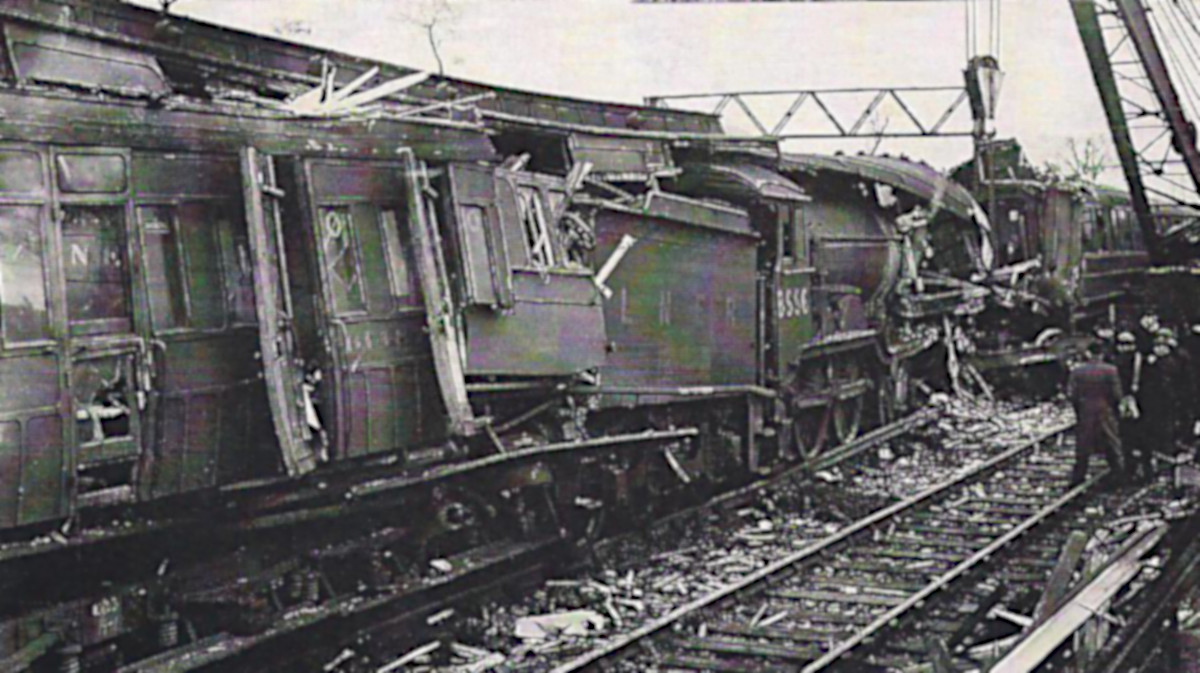
Full report mirrored ((here)) for members. I note a fatalistic conclusion from the inspector - "I have no recommendations". Not quite as simple as that - he does go on to condsider automatic train control, and make comment and a reminder of the need to protect trains as promptly as the circumstances will allow. And the pragmatism is understandable with this being wartime.
Talking of train protection - when were detonators last used to protect trains, or are the still?
| Re: OTD - 10th February (1941) - rear end collision, Harold Wood Posted by Chris from Nailsea at 02:30, 19th February 2022 | |
So far as I know, detonators and black powder cartridges are still in use.
About 15 years ago, my morning commute train broke down at Nailsea & Backwell station, so the relief train had to approach us 'wrong track'. Our train manager / conductor had previously walked quite some distance up the track ahead of our train to attach those items to the tracks, as a required safety precaution.
The result was brilliant, to some of us passengers: it was like a Wild West gunfight out there, with flashes, bangs and clouds of powder-smoke!

CfN

| Re: OTD - 10th February (1941) - rear end collision, Harold Wood Posted by Chris from Nailsea at 10:08, 10th February 2026 | |
Talking of train protection - when were detonators last used to protect trains, or are they still?
From Rail Engineer:
Better possession protection
In 1841 Edward Alfred Cowper, a founder member of the IMechE, devised a warning signal for trains on foggy days. This had a detonating compound packed into a small circular container and was fastened to the rails by lead clips. By 1844 such fog signals were in widespread use and their use was enshrined into the Rule Books of the day. Over 180 years later, this is still the case.
Although the widespread introduction of the Automatic Warning Systems in the 1950s and 1960s removed the need for fog signals, millions of detonators are still in use. At the very least, six detonators are required to protect the 100,000 engineering possessions taken each year and each driving cab must carry 10 detonators to protect the line in the event of a train accident.
Detonators have been used to protect engineering work for over 100 years as specified in the 1950 British Rail Rule Book which required three detonators to be placed 10 yards apart for this purpose. The theory is that detonators will stop irregular moves of engineering trains out of possessions, and of service trains into possessions, as well as providing a warning to track workers of such unauthorised train moves.
In 1841 Edward Alfred Cowper, a founder member of the IMechE, devised a warning signal for trains on foggy days. This had a detonating compound packed into a small circular container and was fastened to the rails by lead clips. By 1844 such fog signals were in widespread use and their use was enshrined into the Rule Books of the day. Over 180 years later, this is still the case.
Although the widespread introduction of the Automatic Warning Systems in the 1950s and 1960s removed the need for fog signals, millions of detonators are still in use. At the very least, six detonators are required to protect the 100,000 engineering possessions taken each year and each driving cab must carry 10 detonators to protect the line in the event of a train accident.
Detonators have been used to protect engineering work for over 100 years as specified in the 1950 British Rail Rule Book which required three detonators to be placed 10 yards apart for this purpose. The theory is that detonators will stop irregular moves of engineering trains out of possessions, and of service trains into possessions, as well as providing a warning to track workers of such unauthorised train moves.
