






Recent Public Posts - [guest]
| Re: "Cancellations on all routes" 24-26 June 2026 In "Across the West" [376509/32162/26] Posted by TaplowGreen at 08:35, 27th June 2026 |      |
I realise thread header is 24-26 June, and today is 27 June
But GWR are continuing the cancellations on all routes banner on their website this morning
The front page of this site is showing
122 cancellations
67 part route
17 reformed
Not great as few days ago message was defer your journey to Friday onwards, so should be expecting both normal Saturday passengers AND some of the deferred passengers. So if anything should be boosting services, not cancelling them.
But GWR are continuing the cancellations on all routes banner on their website this morning
The front page of this site is showing
122 cancellations
67 part route
17 reformed
Not great as few days ago message was defer your journey to Friday onwards, so should be expecting both normal Saturday passengers AND some of the deferred passengers. So if anything should be boosting services, not cancelling them.
Indeed - I get that it's still going to be hot in the London/Thames Valley area today but a large proportion of today's cancellations are citing "severe weather" in areas where there are no "severe weather" issues, crew shortage and "More trains than usual needing repairs at the same time"
| Re: "Cancellations on all routes" 24-26 June 2026 In "Across the West" [376508/32162/26] Posted by John D at 07:38, 27th June 2026 | |
I realise thread header is 24-26 June, and today is 27 June
But GWR are continuing the cancellations on all routes banner on their website this morning
The front page of this site is showing
122 cancellations
67 part route
17 reformed
Not great as few days ago message was defer your journey to Friday onwards, so should be expecting both normal Saturday passengers AND some of the deferred passengers. So if anything should be boosting services, not cancelling them.
| Re: Hotel etiquette In "The West - but NOT trains in the West" [376507/32164/31] Posted by TaplowGreen at 07:14, 27th June 2026 | |
Infoman- most televisions are on a timer these days.
Both TVs in my house turn off after a period of not touching the remote.
Carpets- I’ve stayed in a few Ibis Budgets over the last 18 months across Europe. They don’t tend to have carpets, with a heavy duty Lino type flooring. It feels cleaner to me.
Both TVs in my house turn off after a period of not touching the remote.
Carpets- I’ve stayed in a few Ibis Budgets over the last 18 months across Europe. They don’t tend to have carpets, with a heavy duty Lino type flooring. It feels cleaner to me.
Ibis are universally awful in my experience, the nadir for me was staying in the one outside Euston (now mercifully demolished I believe), checked into my room and found blood on the shower curtain, staff member attended and told me not to worry because it was dry.
Left immediately (without taking the soap), checked into nearest Radisson (for which after much correspondence Ibis picked up the bill) and never went back.
| Re: The same digits but in a different order In "The Lighter Side" [376506/32173/30] Posted by Chris from Nailsea at 06:54, 27th June 2026 | |
Thanks for your posts here, JayMac and TaplowGreen.

Lest there be any of our readers who are unfamiliar with the context, here is a YouTube link to a three minute clip from the Morecambe and Wise Christmas Show of 1971.
CfN.


| Re: Hotel etiquette In "The West - but NOT trains in the West" [376505/32164/31] Posted by infoman at 06:49, 27th June 2026 | |
Fair enough on the soap front but we take are own soap and toilet rolls with us.
Who recalls that sand paper called izel?
Just ask your great grand parents.
Regarding the kettles,wish they were all stainless steel as opposed to plastic,you can taste the plastic when you make a hot drink.
Stainless steel is easier to recycle than plastic.
| What happened when I tried to report sexual assault to British Transport Police In "The Wider Picture in the United Kingdom" [376504/32176/51] Posted by Chris from Nailsea at 06:35, 27th June 2026 | |
From the BBC:
See it, say it, not sorted. I was let down when I reported my train sexual assault
At about 11pm on a Saturday night a couple of weeks ago, Esme Rice was on the Elizabeth Line that runs across London. She was travelling home after dinner with friends in Farringdon when two men boarded the busy carriage she was in.
"One of the men tried getting my attention," Esme says, "but I ignored him and waited for my stop."
As the train was pulling into Stratford station, one of the men stroked Esme's back. The second man stood in her way as she tried to get off, and as she hurried past him, Esme says he groped her.
"It all happened so quickly it took a moment for my brain to catch up," she says. "I turned towards them and they were grinning, like it was a joke. Then, they were gone. I stood on the platform feeling stunned, afraid and violated."
It was a typical lively Saturday evening with plenty of people around, but no police officers.
Then words Esme had heard many times on trains and at stations suddenly echoed in her head.
"See it. Say it. Sorted."
She texted the British Transport Police (BTP) on 61016, the dedicated line for reporting non-emergency incidents on the rail network. The BTP say they will respond to any crime - from antisocial behaviour to terrorism - within their jurisdiction, which covers more than 10,000 miles of track and roughly 3,000 stations.
An automated reply came back which said Esme's report mattered and that someone would call her "shortly". Then Esme was asked via text message to provide more detail, so she sent descriptions of what had happened, when and where, and waited for their call.
But 13 hours after being sexually assaulted on one of the country's busiest transport networks, Esme still had not heard back from anyone. So she decided to post about her experience on social media.
"I recorded myself with my phone, describing the incident, saying how frustrated I was about the lack of response, and included a screenshot of the message I'd received from police," she says.
Esme posted the videos onto her Instagram and TikTok accounts and within an hour, they had been viewed thousands of times. She says there were hundreds of comments, including messages from women who said they understood exactly what she was talking about.
"Not long after that I received a call from the BTP," Esme says. "They told me they had opened an investigation and arranged a time to take my statement."
Details of help and support with sexual abuse or violence are available at BBC Action Line
BTP told the BBC their call that day had not been prompted by Esme's video.
"But I couldn't ignore the timing," she says. "I had reported the assault privately and heard nothing. I spoke publicly, and suddenly there was urgency."
A day later, a comment from BTP's official social media account appeared among the hundreds of others alongside Esme's video.
"We're sorry you have been subjected to this awful behaviour on the railway. We treat all reports of sexual assault extremely seriously," the comment read, which was followed by a statement that an investigation had been launched.
Assistant Chief Constable Ian Drummond-Smith then called Esme and acknowledged that a 13-hour delay was far too long.
"He said I should have been called the same evening I reported the incident," says Esme. "I have since been informed there is now an internal investigation into why I was not offered additional support that night."
BTP launched its now very familiar public safety slogan a decade ago. The phrase - See it. Say it. Sorted - is broadcast over public address systems in stations and on trains, and features prominently on posters across the rail network.
Recent awareness campaigns specifically name-check pressing, touching, staring and upskirting as forms of sexual harassment that are not tolerated on public transport - and promise action.
But Esme says that, based on her experience, it doesn't feel like the BTP is able to respond quickly enough to really protect people when they report an incident - or deter unwanted behaviour. "This wasn't the first time I felt like I had received a poor response after reporting an incident to the BTP," she says.
Esme says she was also sexually harrassed two years previously, while travelling with a friend on a Jubilee Line train, at 6pm one day in March. "I noticed a man standing close to me, touching himself," she says. "I moved away, but then looked down and realised that he had moved closer again and was masturbating against me. I remember the shock - I shouted at him, I took pictures, I called him out loudly, so everyone on that packed train could hear. No-one stepped in."
Esme says her friend moved her down the carriage, and when they reached Stratford they went straight to police who were stationed on the platform. She gave them a statement, she says, which was written up the next day, and BTP found the man on CCTV. But a media appeal that asked the public for further information about the person captured on CCTV went out weeks later - not as soon as the footage was found. No identification was made, and by mid-April Esme was told no further action could be taken.
The videos Esme posted after being sexually assaulted the second time exploded online. At the time of writing they have had more than 500,000 views, and messages have poured in from people sharing similar experiences. "Some people get it wrong in the comments - they try blaming me for the fact that it happened, or they leave racist comments about the attackers," she says. "But I want to make it clear - this could happen to anyone."
Figures released at the end of 2025 show reports of sexual offences on the London Underground reached their highest level in five years. There were 595 sexual offences across all Tube lines in 2024-25, the most since 2019-20 when there were 776 reports.
The data, which was released by TfL in response to a Freedom of Information request, did not include the London Overground, DLR or Elizabeth Line. At the time TfL said: "Tackling violence against women and girls on public transport has long been a priority for us and our policing partners, and concerted action has been undertaken for a number of years."
Just three days after Esme's assault, on 9 June 2026 a passenger was convicted under new sex-based harassment legislation. He had grabbed a woman's hair and tried to kiss her on a train going into London, describing it as "banter". He was sentenced to a 12-month community order, 150 hours of unpaid work and a 15-day rehabilitation programme.
The BTP told the BBC that tackling sexual offending on the transport network is a priority as it is "committed to protecting everyone's right to a safe journey".
"The 61016 number receives more than 250,000 texts every year - and this figure continues to rise as confidence grows among passengers in reporting historically under-reported crimes, such as sexual offending," a spokesperson said. "This isn't misplaced confidence, as we've shown time and time again that we won't stop until we've caught offenders, put them before the courts, and secured justice for victims."
At about 11pm on a Saturday night a couple of weeks ago, Esme Rice was on the Elizabeth Line that runs across London. She was travelling home after dinner with friends in Farringdon when two men boarded the busy carriage she was in.
"One of the men tried getting my attention," Esme says, "but I ignored him and waited for my stop."
As the train was pulling into Stratford station, one of the men stroked Esme's back. The second man stood in her way as she tried to get off, and as she hurried past him, Esme says he groped her.
"It all happened so quickly it took a moment for my brain to catch up," she says. "I turned towards them and they were grinning, like it was a joke. Then, they were gone. I stood on the platform feeling stunned, afraid and violated."
It was a typical lively Saturday evening with plenty of people around, but no police officers.
Then words Esme had heard many times on trains and at stations suddenly echoed in her head.
"See it. Say it. Sorted."
She texted the British Transport Police (BTP) on 61016, the dedicated line for reporting non-emergency incidents on the rail network. The BTP say they will respond to any crime - from antisocial behaviour to terrorism - within their jurisdiction, which covers more than 10,000 miles of track and roughly 3,000 stations.
An automated reply came back which said Esme's report mattered and that someone would call her "shortly". Then Esme was asked via text message to provide more detail, so she sent descriptions of what had happened, when and where, and waited for their call.
But 13 hours after being sexually assaulted on one of the country's busiest transport networks, Esme still had not heard back from anyone. So she decided to post about her experience on social media.
"I recorded myself with my phone, describing the incident, saying how frustrated I was about the lack of response, and included a screenshot of the message I'd received from police," she says.
Esme posted the videos onto her Instagram and TikTok accounts and within an hour, they had been viewed thousands of times. She says there were hundreds of comments, including messages from women who said they understood exactly what she was talking about.
"Not long after that I received a call from the BTP," Esme says. "They told me they had opened an investigation and arranged a time to take my statement."
Details of help and support with sexual abuse or violence are available at BBC Action Line
BTP told the BBC their call that day had not been prompted by Esme's video.
"But I couldn't ignore the timing," she says. "I had reported the assault privately and heard nothing. I spoke publicly, and suddenly there was urgency."
A day later, a comment from BTP's official social media account appeared among the hundreds of others alongside Esme's video.
"We're sorry you have been subjected to this awful behaviour on the railway. We treat all reports of sexual assault extremely seriously," the comment read, which was followed by a statement that an investigation had been launched.
Assistant Chief Constable Ian Drummond-Smith then called Esme and acknowledged that a 13-hour delay was far too long.
"He said I should have been called the same evening I reported the incident," says Esme. "I have since been informed there is now an internal investigation into why I was not offered additional support that night."
BTP launched its now very familiar public safety slogan a decade ago. The phrase - See it. Say it. Sorted - is broadcast over public address systems in stations and on trains, and features prominently on posters across the rail network.
Recent awareness campaigns specifically name-check pressing, touching, staring and upskirting as forms of sexual harassment that are not tolerated on public transport - and promise action.
But Esme says that, based on her experience, it doesn't feel like the BTP is able to respond quickly enough to really protect people when they report an incident - or deter unwanted behaviour. "This wasn't the first time I felt like I had received a poor response after reporting an incident to the BTP," she says.
Esme says she was also sexually harrassed two years previously, while travelling with a friend on a Jubilee Line train, at 6pm one day in March. "I noticed a man standing close to me, touching himself," she says. "I moved away, but then looked down and realised that he had moved closer again and was masturbating against me. I remember the shock - I shouted at him, I took pictures, I called him out loudly, so everyone on that packed train could hear. No-one stepped in."
Esme says her friend moved her down the carriage, and when they reached Stratford they went straight to police who were stationed on the platform. She gave them a statement, she says, which was written up the next day, and BTP found the man on CCTV. But a media appeal that asked the public for further information about the person captured on CCTV went out weeks later - not as soon as the footage was found. No identification was made, and by mid-April Esme was told no further action could be taken.
The videos Esme posted after being sexually assaulted the second time exploded online. At the time of writing they have had more than 500,000 views, and messages have poured in from people sharing similar experiences. "Some people get it wrong in the comments - they try blaming me for the fact that it happened, or they leave racist comments about the attackers," she says. "But I want to make it clear - this could happen to anyone."
Figures released at the end of 2025 show reports of sexual offences on the London Underground reached their highest level in five years. There were 595 sexual offences across all Tube lines in 2024-25, the most since 2019-20 when there were 776 reports.
The data, which was released by TfL in response to a Freedom of Information request, did not include the London Overground, DLR or Elizabeth Line. At the time TfL said: "Tackling violence against women and girls on public transport has long been a priority for us and our policing partners, and concerted action has been undertaken for a number of years."
Just three days after Esme's assault, on 9 June 2026 a passenger was convicted under new sex-based harassment legislation. He had grabbed a woman's hair and tried to kiss her on a train going into London, describing it as "banter". He was sentenced to a 12-month community order, 150 hours of unpaid work and a 15-day rehabilitation programme.
The BTP told the BBC that tackling sexual offending on the transport network is a priority as it is "committed to protecting everyone's right to a safe journey".
"The 61016 number receives more than 250,000 texts every year - and this figure continues to rise as confidence grows among passengers in reporting historically under-reported crimes, such as sexual offending," a spokesperson said. "This isn't misplaced confidence, as we've shown time and time again that we won't stop until we've caught offenders, put them before the courts, and secured justice for victims."
| Re: Greetings from Milan, where it's too hot to eat out. In "Introductions and chat" [376503/32175/1] Posted by Chris from Nailsea at 21:19, 26th June 2026 | |
Hmm. I would tend to disagree, grahame, regarding 'helicopter parent'.
The anonymous lad is 23, he's not travelled solo before, and is travelling a fair distance across different countries in Europe, with various language considerations, etc.
My own daughter, age 28, is not an expert on travelling solo within the UK: on one occasion, I had to retrieve her from Didcot Parkway, as she'd managed to get there instead of a (slightly diverted, due to engineering work) journey from Cardiff to Nailsea.
CfN.

| Re: Grand Central Waterloo-Bristol open access In "London to Swindon and Bristol" [376502/32154/10] Posted by grahame at 21:05, 26th June 2026 | |
Off the top of my head - am I correct in saying that this proposed service will actually provide a quicker WAT to SAL service than that provided by the steam hauled ACE - up to 1964 ! Is this what they call progress ?
Provisional timetable is 76-78 minutes from Waterloo
About 8-10 minutes faster than Waterloo-Exeter trains with 159s
I would suggest that's because it's almost non-stop, not calling at Basingstoke or Woking - just Clapham Junction. I also noted brisk timings from Bristol to Bath, sandwiched between Portsmouth Harbour and London trains; no stops showing at Keynsham or Oldfield Park and indeed a problem if they tried. The service pattern may hint at the main market they are after.
| Greetings from Milan, where it's too hot to eat out. In "Introductions and chat" [376501/32175/1] Posted by grahame at 20:58, 26th June 2026 | |
Greetings from Milan, where it's so hot that no-one is sitting at the outside tables - they're all inside at the restaurants with AC which are busy. Those without AC are empty. My train left Brindisi on time but was about 25 minutes down by the time it completed over 1000 kms to Milan. I can't identify any one delay - not that I would recognise unusually slow running in any particular area as it's the first time I've done the journey.
I have chickened out, with the Kentucky fried version back in my room where I can reduce clothing for comfort and plan for tomorrow. Clockface hourly trains without reservations and I have the luxury that give me of being able to be flexible. There *is* a TV in the room - there has been everywhere - but I have not used them; rather a quick check with general sites including the BBC to see what's happening in the world, some social media, some email, and the Coffee Shop. And it was on the social media I can across this gem from an anonymous poster.
I've got a quick question. My 23-year-old son will be traveling solo this fall to Albania. He has already been to Europe twice, however but I’m just looking for any tips, suggestions, things to be wary of as this will be his first time traveling internationally completely solo. I am a seasoned European traveler myself so I don’t need general suggestions as much as information to be aware of specific to Albania. He will be renting a car as well so any suggestions about reputable car rental agencies so as not to have him get screwed over with bogus charges and such.
I found myself - without knowing any specific circumstances - thinking "helicopter parent". Surely the lad could and should do his own research, and if not perhaps he should not be travelling solo ...
| Re: Grand Central Waterloo-Bristol open access In "London to Swindon and Bristol" [376500/32154/10] Posted by John D at 20:18, 26th June 2026 Already liked by Mark A | |
Off the top of my head - am I correct in saying that this proposed service will actually provide a quicker WAT to SAL service than that provided by the steam hauled ACE - up to 1964 ! Is this what they call progress ?
Provisional timetable is 76-78 minutes from Waterloo
About 8-10 minutes faster than Waterloo-Exeter trains with 159s
Don't have a 1964 timetable, but have copy of one of the last Southern Railway ones, and Salisbury was about 2 hours by the fastest trains to beyond Exeter
| Re: Swindon <-> Westbury service updates and amendments, ongoing discussion - 2026 In "TransWilts line - Swindon, Chippenham, Melksham, Trowbridge, Westbury, Salisbury" [376499/31359/18] Posted by grahame at 19:24, 26th June 2026 | |
20:06 Westbury to Cheltenham Spa due 22:06
20:06 Westbury to Cheltenham Spa due 22:06 will be terminated at Gloucester.
It will no longer call at Cheltenham Spa.
This is due to a shortage of train crew.
20:06 Westbury to Cheltenham Spa due 22:06 will be terminated at Gloucester.
It will no longer call at Cheltenham Spa.
This is due to a shortage of train crew.
| Re: Swindon <-> Westbury service updates and amendments, ongoing discussion - 2026 In "TransWilts line - Swindon, Chippenham, Melksham, Trowbridge, Westbury, Salisbury" [376498/31359/18] Posted by grahame at 19:14, 26th June 2026 | |
18:37 Westbury to Swindon due 19:21
20:12 Swindon to Westbury due 20:56
21:16 Westbury to Swindon due 21:58
22:31 Swindon to Westbury due 23:12
22:31 Swindon to Westbury due 23:12 will be cancelled.
This is due to a fault on this train
20:12 Swindon to Westbury due 20:56
21:16 Westbury to Swindon due 21:58
22:31 Swindon to Westbury due 23:12
22:31 Swindon to Westbury due 23:12 will be cancelled.
This is due to a fault on this train
| Re: Grand Central Waterloo-Bristol open access In "London to Swindon and Bristol" [376497/32154/10] Posted by Clan Line at 18:34, 26th June 2026 Already liked by Mark A | |
Off the top of my head - am I correct in saying that this proposed service will actually provide a quicker WAT to SAL service than that provided by the steam hauled ACE - up to 1964 ! Is this what they call progress ?
| Re: Squirrels - red, grey or albino, on the railways or otherwise - ongoing discussion In "The Lighter Side" [376496/5560/30] Posted by Chris from Nailsea at 18:26, 26th June 2026 | |
A video item, from the BBC:
Squirrels tackle Wimbledon challenge in Hitchin back garden
It's a video piece, so you'll need to click on the BBC's link, at https://www.bbc.co.uk/news/videos/ckg01kz8gnzo
Less than a minute, but it's pure fun.

| Re: The same digits but in a different order In "The Lighter Side" [376495/32173/30] Posted by TaplowGreen at 17:35, 26th June 2026 Already liked by Clan Line, Oxonhutch, Chris from Nailsea, chuffed, IndustryInsider, JayMac | |
| Re: Bristol Temple Meads unusual activity In "Heritage railways, Railtours, buses, canals, steamships and other public transport based attractions" [376494/32174/47] Posted by Mark A at 17:22, 26th June 2026 | |
The class 47... one of the types of loco that, for the brief time that that station, the line and the locos coexisted, passed through Nottingham Victoria on long distance express duties.
Mark
| Re: "Cancellations on all routes" 24-26 June 2026 In "Across the West" [376493/32162/26] Posted by grahame at 17:19, 26th June 2026 | |
Cancellations to services between Par and Newquay
Due to severe weather between Par and Newquay fewer trains are able to run.
The temperature in Newquay is 18 degrees
Cancellations to services between Truro and Falmouth Docks
Due to severe weather between Truro and Falmouth Docks fewer trains are able to run on some lines.
We are running an amended service during the severe heat event in line with the Met Office red weather warning.
The temperature in Truro is 18 degrees and expected to rise to 22-23 degrees today. There is no weather warning in place.
Due to severe weather between Par and Newquay fewer trains are able to run.
The temperature in Newquay is 18 degrees
Cancellations to services between Truro and Falmouth Docks
Due to severe weather between Truro and Falmouth Docks fewer trains are able to run on some lines.
We are running an amended service during the severe heat event in line with the Met Office red weather warning.
The temperature in Truro is 18 degrees and expected to rise to 22-23 degrees today. There is no weather warning in place.
As written in a Friends post on social media a couple of hours ago:
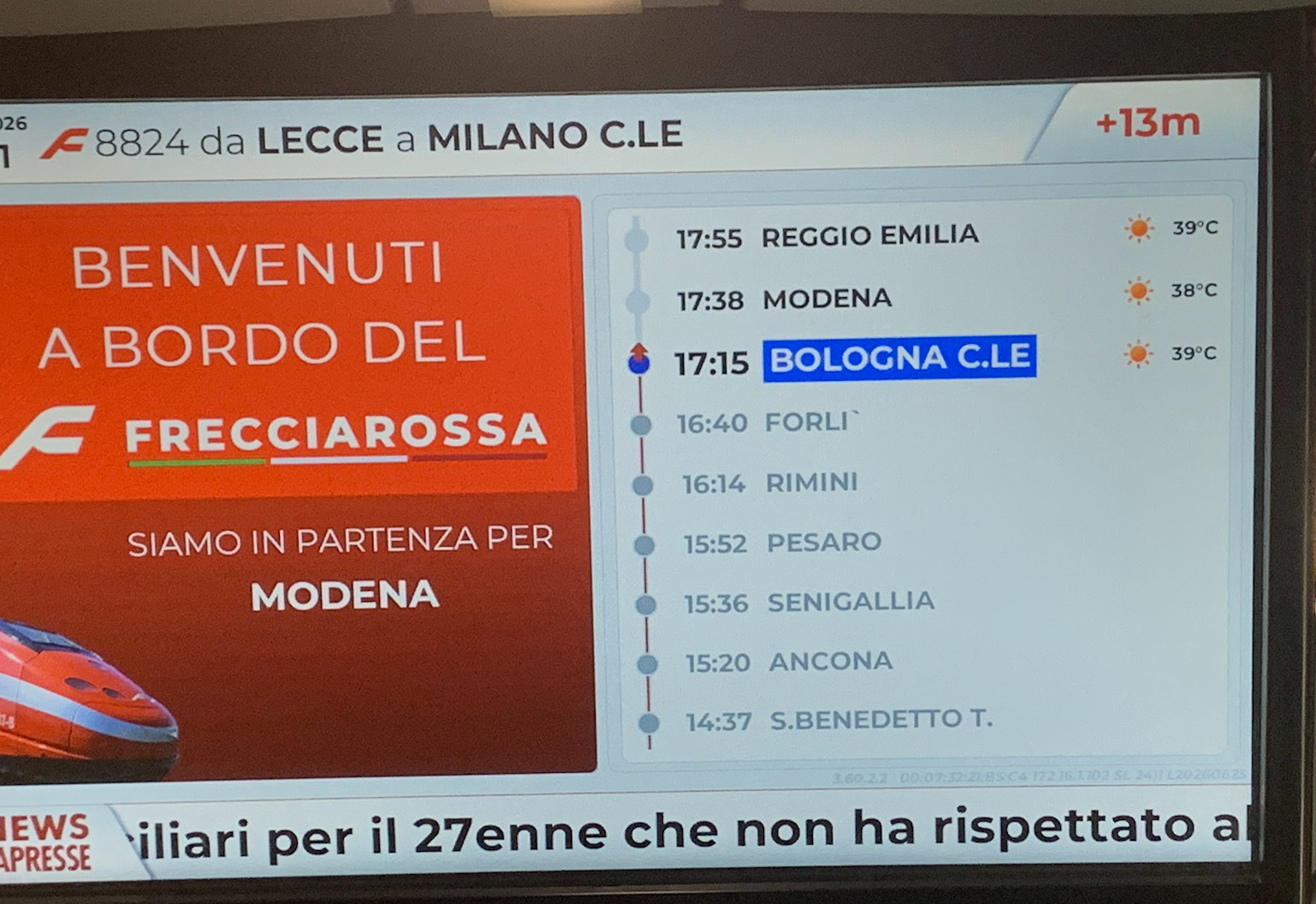
Lecce - Brindisi - Bari - Barletta - Foggia - Termoli - Pescara - Ancona - Pesaro - Rimini - Bologna - Modena - Milano. The train I am on is calling at this catalogue of Italian cities - not that I have time to see any of them as we stop for a few seconds only. It is, perhaps, a typical long distancce express, with only a sprinking of passengers on board when I joined it at Brindisi, but now as we approach Ancona it's "every seat taken". I knew that would be the case, as it's a "reservations only" train and the reserved seat plan had meagre pickings when I booked 48 hours ago. Staying on all the way to Milan and thinking of interesting comparisons to Cross Country trains in the UK. We avoid Rome, just like the UK's Cross Country services avoid London.
Lecce - Ancona - 596 kms; Ancona - Bologna - another 202 kms; Bologna - Milano - another 215 kms; Total 1013 kms - virtually the same as London to Ullapool (port for the Outer Hebrides, well beyond Inverness). Haven't been to Milan for - err - 21 days doubt it has changed. Seriously, a city in which I have never left the station and even this time it's just overnight and a couple of hundred yards from the station.
Lecce - Ancona - 596 kms; Ancona - Bologna - another 202 kms; Bologna - Milano - another 215 kms; Total 1013 kms - virtually the same as London to Ullapool (port for the Outer Hebrides, well beyond Inverness). Haven't been to Milan for - err - 21 days doubt it has changed. Seriously, a city in which I have never left the station and even this time it's just overnight and a couple of hundred yards from the station.
Hot, late, but running here in Italy - here is the latest
| Re: The same digits but in a different order In "The Lighter Side" [376492/32173/30] Posted by JayMac at 17:00, 26th June 2026 Already liked by johnneyw | |
The thread title suggests some sort of Morecombe & Wise sketch.

| Re: The same digits but in a different order In "The Lighter Side" [376491/32173/30] Posted by grahame at 16:23, 26th June 2026 Already liked by Mark A | |
Graham's train, with a link to a map. Bologna in an hour, and once day he'll take a ride on the Porrettana. Or perhaps he already has...
Mark
https://treniamo.it/en/train/8824-lecce-milano-centrale
Mark
https://treniamo.it/en/train/8824-lecce-milano-centrale
That is a link to the train I am on. Yes - Italian trains tend to set off on time and loose time along the way. Due in at 19:10 and I was very careful what I wrote - schedules 19:10, expected perhaps 19:30 to 19:40. My hotel won't be going anywhere, so delay really does not matter to me.
| Re: The same digits but in a different order In "The Lighter Side" [376490/32173/30] Posted by Mark A at 15:42, 26th June 2026 | |
Graham's train, with a link to a map. Bologna in an hour, and once day he'll take a ride on the Porrettana. Or perhaps he already has...
Mark
https://treniamo.it/en/train/8824-lecce-milano-centrale
| Bristol Temple Meads unusual activity In "Heritage railways, Railtours, buses, canals, steamships and other public transport based attractions" [376489/32174/47] Posted by JohnM at 13:26, 26th June 2026 Already liked by Mark A | |
After going through the Temple Meads barriers on the way home yesterday ( https://www.firstgreatwestern.info/coffeeshop/index.php?topic=32162.msg376479#msg376479 ) I could see what looked like heritage coaches on the platform opposite, but couldn't see what was pulling them due to a non-heritage service blocking that end of the view on the platform I was standing on. So I moved down the platform, hoping to perhaps see a nice steam engine. But instead:
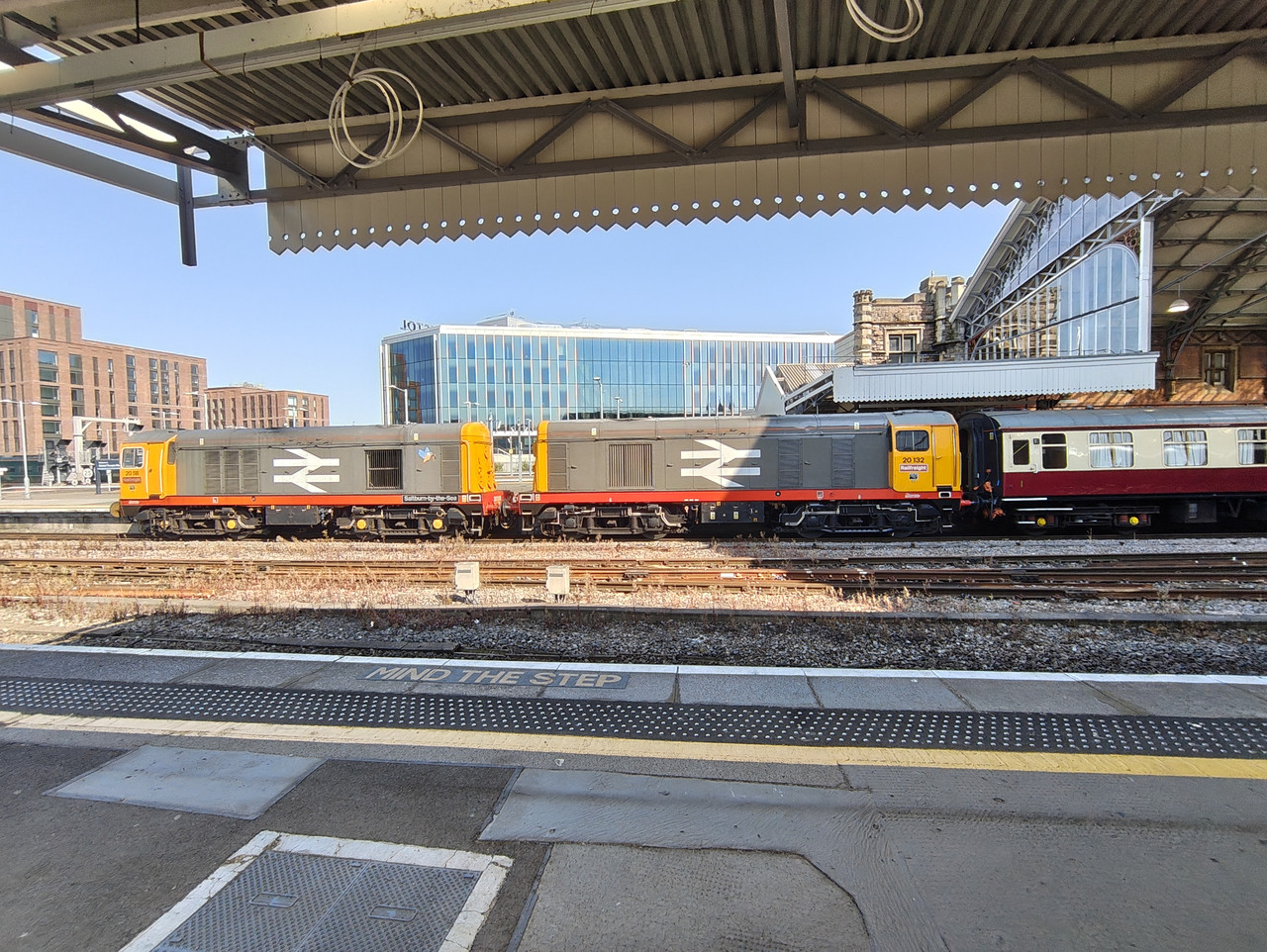
Not being an expert in this sort of thing I was a bit underwhelmed. But apparently I shouldn't have been:
This particular movement attracted significant attention from rail enthusiasts because it was operated by Locomotive Services Limited (LSL) using highly unusual traction for the region: a pair of vintage Class 20 locomotives (20118 and 20132) leading the train, with Class 47 (47712) attached to the rear. The stock was being returned following a charter railtour to Shrewsbury the previous day.
(I only saw the class 47 when the train pulled out.) So now I know | Re: "Cancellations on all routes" 24-26 June 2026 In "Across the West" [376488/32162/26] Posted by eightonedee at 13:03, 26th June 2026 | |
That wouldn't happen here I'd guess because operators would rather use the space to cram in more seats.
If only.... During the latter part of my commuting career, seats were removed from 2-car class 165s for some cycle/luggage storage that looks unsuitable for either function, and seats were also removed from the middle coaches of class 166s for additional wheelchair space - not a problem to provide it, by why not replace it with tip-up seating that can be used when (as on the majority of journeys) there are no wheelchair users on board. I think that these are DfT/ORR requirements, as is the continued use of 5-across seating on our relatively restricted sized trains, compared to the rest of Europe.
| Re: Grand Central Waterloo-Bristol open access In "London to Swindon and Bristol" [376487/32154/10] Posted by IndustryInsider at 12:12, 26th June 2026 Already liked by Mark A, Western Pathfinder | |
| Re: Swindon <-> Westbury service updates and amendments, ongoing discussion - 2026 In "TransWilts line - Swindon, Chippenham, Melksham, Trowbridge, Westbury, Salisbury" [376486/31359/18] Posted by grahame at 11:57, 26th June 2026 | |
And after all that, if you had caught the 07:21 and gone via Reading you would have arrived in Southampton Central just over 20 minutes late at 10:05 (but got delay repay).
Sorta point-of-view. If you had caught the 06:29 as planned, you would have planned an arrival into Southampton at 08:10 - so you (and your employer or a person meeting you) might consider that 115 minutes late
| Re: Swindon <-> Westbury service updates and amendments, ongoing discussion - 2026 In "TransWilts line - Swindon, Chippenham, Melksham, Trowbridge, Westbury, Salisbury" [376485/31359/18] Posted by bobm at 11:21, 26th June 2026 | |
And after all that, if you had caught the 07:21 and gone via Reading you would have arrived in Southampton Central just over 20 minutes late at 10:05 (but got delay repay).
| Re: Hotel etiquette In "The West - but NOT trains in the West" [376484/32164/31] Posted by PrestburyRoad at 09:26, 26th June 2026 Already liked by Chris from Nailsea | |
Regarding the little bottles of soap, shampoo etc: if I've started a bottle I'll take part-empty bottle with me to use up at home, because I assume that the hotel won't reuse it. Whereas if I haven't started it I'll leave it for the hotel to provide for the next guest.
| Re: Swindon <-> Westbury service updates and amendments, ongoing discussion - 2026 In "TransWilts line - Swindon, Chippenham, Melksham, Trowbridge, Westbury, Salisbury" [376483/31359/18] Posted by grahame at 08:19, 26th June 2026 | |
05:11 Gloucester to Southampton Central due 08:10
05:11 Gloucester to Southampton Central due 08:10 will be cancelled.
This is due to more trains than usual needing repairs at the same time.
05:11 Gloucester to Southampton Central due 08:10 will be cancelled.
This is due to more trains than usual needing repairs at the same time.
JourneyCheck is struggling with 250 cancellations and part cancellations this morning and I suspect that the bloke or blokessse who feed it are overworked. There are regular users of this train though, and it would be a politeness for the people or systems that tell them their train is cancelled to tell them the alternative. This IS used as a get-to-work train by people to Bristol and Southampton.
Searching on GWR, the best they offer is a train that gets people to Southampton and hour and a half later, at a much higher price (cheeky when they cancelled the train). If I were personally travelling, I would take a look at the bus option to Trowbridge which would certainly be cheaper and probably get me to Southampton earlier than the 07:21 via Reading!
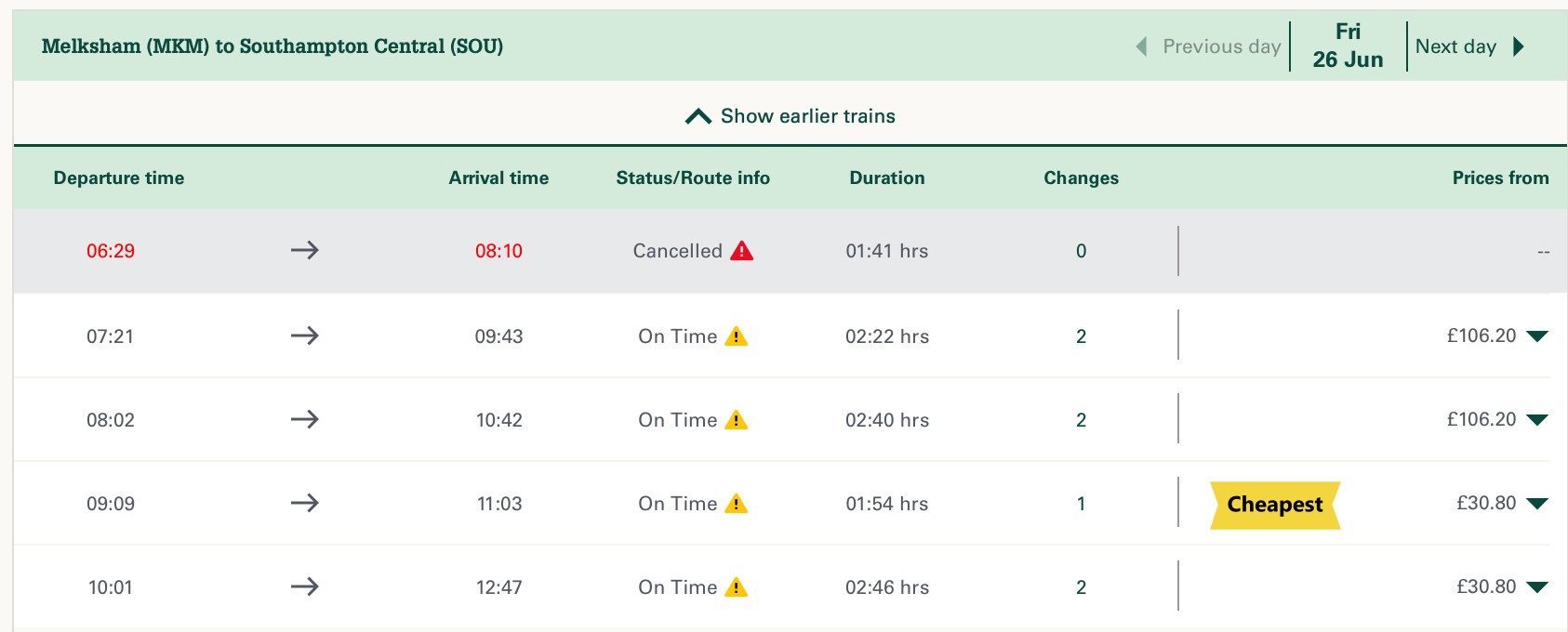
Yep - 06:50 bus from Broughton Road to Trowbridge Trinity Church (you'll note it takes 30 minutes by bus and 10 minutes by train!) and then the 07:53 train from Trowbridge to Southampton Central, due 09:03. £3 bus fare plus £30.10 which is a darned site cheaper than the £106.20 GWR will have you pay if you don't know, and gets you there still late - but 40 minutes after the train they offer you having cancelled the 06:29.
Another good reason to have a knowledgable person able to offer help at the station!
| Re: "Cancellations on all routes" 24-26 June 2026 In "Across the West" [376482/32162/26] Posted by REVUpminster at 08:19, 26th June 2026 | |
No trains to Newquay, Looe, one train for Okehampton and Falmouth, short forms at Paignton with no xcountry there since Tuesday and no arrival from Paddington today.
GWR have done a good job of scaring the passengers off. They not worried if they don't come back. Where will the management be in December?
| Re: Hotel etiquette In "The West - but NOT trains in the West" [376481/32164/31] Posted by LiskeardRich at 08:00, 26th June 2026 | |
Infoman- most televisions are on a timer these days.
Both TVs in my house turn off after a period of not touching the remote.
Carpets- I’ve stayed in a few Ibis Budgets over the last 18 months across Europe. They don’t tend to have carpets, with a heavy duty Lino type flooring. It feels cleaner to me.
I’ve also used a selection of independent hotels recently. I’ve found the beds to be of variable quality, and in Prague I had a terrible night sleep, which made me grumpier than usual. It skewed my opinion of Prague because I was tired. Combination of noise, poor sound deadening in a noisy location.
I stayed in a beautiful place in Zakopane, amazing sleep. Very quiet. Ran by a senior lady and her daughter. Zakopane is my favourite place I’ve visited this year. Is my opinion of a place biased by how well i slept?
Most of my sleep quality has been a result of surrounding noise. Other guests, external noises.
Until the last 18 months I solely booked the big purple branded chain as I knew what I’d get. I’ve pushed myself out of my comfort zone and stayed in a wide selection of independents and other chains in the last 18 months. I notice peoples etiquette to the small independent different to in a chain.
| Re: "Cancellations on all routes" 24-26 June 2026 In "Across the West" [376480/32162/26] Posted by TaplowGreen at 07:06, 26th June 2026 | |
Cancellations to services between Par and Newquay
Due to severe weather between Par and Newquay fewer trains are able to run.
The temperature in Newquay is 18 degrees
Cancellations to services between Truro and Falmouth Docks
Due to severe weather between Truro and Falmouth Docks fewer trains are able to run on some lines.
We are running an amended service during the severe heat event in line with the Met Office red weather warning.
The temperature in Truro is 18 degrees and expected to rise to 22-23 degrees today. There is no weather warning in place.
