







Recent Public Posts - [guest]
| Re: Swindon <-> Westbury service updates and amendments, ongoing discussion - 2026 In "TransWilts line" [375626/31359/18] Posted by grahame at 19:34, 29th May 2026 |      |
17:50 Gloucester to Salisbury due 20:06
Facilities on the 17:50 Gloucester to Salisbury due 20:06.
Toilet facilities are not available.
This is due to a fault on this train.
Additional Information
Toilets are not available on this train - There will be Toilet stops at some stations on your Journey
Facilities on the 17:50 Gloucester to Salisbury due 20:06.
Toilet facilities are not available.
This is due to a fault on this train.
Additional Information
Toilets are not available on this train - There will be Toilet stops at some stations on your Journey
| Re: North Cotswold line delays and cancellations - 2026 In "London to the Cotswolds" [375625/31371/14] Posted by charles_uk at 17:41, 29th May 2026 | |
15:52 London Paddington to Great Malvern due 18:26 will be cancelled.
This is due to a member of on-train staff being taken ill.
19:02 Great Malvern to London Paddington due 21:28 will be cancelled.
This is due to a member of on-train staff being taken ill.
This is due to a member of on-train staff being taken ill.
19:02 Great Malvern to London Paddington due 21:28 will be cancelled.
This is due to a member of on-train staff being taken ill.
| Re: Mid Cornwall Metro - Newquay, St Austell, Truro & Falmouth In "Shorter journeys in Plymouth and Cornwall" [375624/27102/25] Posted by Andy at 16:54, 29th May 2026 Already liked by Mark A | |
Has anyone had any information regarding loadings since the new timetable was introduced? It's very early days, there have been some "teething troubles" and changes will take time to embed but I'm curious about early signs.
| Re: Class 175s to Great Western Railway (GWR) In "Across the West" [375623/28982/26] Posted by JohnM at 15:58, 29th May 2026 Already liked by IndustryInsider, rogerw | |
175s use a similar effluent system to Voyagers; the waste is stored in an upright tank behind the toilet rather than slung below and some stink as bad.
AI's view...The Voyager "Boiled Sewage" Flaw
The severe odor issues on the Voyagers came down to an incredibly unfortunate layout of the underfloor components, combined with a bad choice of location for the climate control system:
Why the Class 175 Avoided This
While the Class 175s were designed and built at roughly the same time (late 1990s to early 2000s), they were manufactured by Alstom, whereas the Voyagers were built by Bombardier.
Alstom's packaging layout underneath the Class 175 frames was entirely different. The effluent tanks were isolated cleanly from the engine exhausts, and the air conditioning pods were mounted on the roof rather than drawing air from beneath the chassis. Because of this, the 175s generally smell like a normal train inside—their underfloor issues were strictly mechanical and flammable, rather than olfactory.
The severe odor issues on the Voyagers came down to an incredibly unfortunate layout of the underfloor components, combined with a bad choice of location for the climate control system:
- The Heating Problem: On the Voyagers, some of the engine exhaust piping was routed directly alongside or underneath the Controlled Emission Toilet (CET) retention tanks. In the summer—or when the engines were working hard—the extreme heat from the exhausts effectively "cooked" the raw sewage inside the tanks, causing intense gas build-up and a foul stench.
- The Intake Problem: To make matters worse, the fresh-air intake vents for the passenger saloon’s air conditioning system were located under the chassis, right in the vicinity of those heated effluent tanks.
- The Result: The air conditioning system regularly sucked in the escaping sewage fumes and actively pumped a concentrated aroma of warm, stale urine and sulfur directly into the passenger cabins, particularly around the vestibules.
Why the Class 175 Avoided This
While the Class 175s were designed and built at roughly the same time (late 1990s to early 2000s), they were manufactured by Alstom, whereas the Voyagers were built by Bombardier.
Alstom's packaging layout underneath the Class 175 frames was entirely different. The effluent tanks were isolated cleanly from the engine exhausts, and the air conditioning pods were mounted on the roof rather than drawing air from beneath the chassis. Because of this, the 175s generally smell like a normal train inside—their underfloor issues were strictly mechanical and flammable, rather than olfactory.
| Re: Class 175s to Great Western Railway (GWR) In "Across the West" [375622/28982/26] Posted by TaplowGreen at 12:52, 29th May 2026 Already liked by Andy E | |
175s use a similar effluent system to Voyagers; the waste is stored in an upright tank behind the toilet rather than slung below and some stink as bad.
So whilst you can't polish a turd, you can store them on board the train.
| Re: Class 175s to Great Western Railway (GWR) In "Across the West" [375621/28982/26] Posted by plymothian at 12:50, 29th May 2026 | |
175s use a similar effluent system to Voyagers; the waste is stored in an upright tank behind the toilet rather than slung below and some stink as bad.
| Re: New Oxford - Bristol direct service, ongoing developments and discussion In "Oxford, Didcot and Reading from the West" [375620/28355/22] Posted by JohnM at 10:34, 29th May 2026 | |
BTW I think they cleared that broken down freight train fairly promptly; it might have been better to stay at BTM and wait for the next 'normal' Melksham route via Bath instead of hopping on the diverted 17:29. Can't be bothered to check, might not like the answer 

Looking at what happened to the Transwilts service last night, if you'd waited any longer you may well still be travelling now!
As I was 78 mins late I only claimed for a 60-119 mins delay, 50% of a return ticket, but they've refunded the full £10.25

| Re: Shortage of train crews on Great Western Railway - ongoing discussion In "Across the West" [375619/18719/26] Posted by TaplowGreen at 09:07, 29th May 2026 | |
According to Mark Hopwood yesterday at Travelwatch Southwest, further cuts are being made to the Summer Sunday timetable at the May timetable change, as part of the management of this problem.
........as part of the failure of management of this problem - fixed it for you!
ORR have issued new quarterly figures, and according to table 1.3 GWR has planned to cut 2% of services compared to previous year.
https://dataportal.orr.gov.uk/media/4pmhex4x/performance-stats-release-jan-mar-2026.pdf
So all the PR spin of increasing services to Newquay, and introducing Bristol-Oxford there is an overall cut (which has rather been kept under the radar)
Robbing Peter to pay Paul (...........or perhaps Mark in this context)
| Re: A train trip in the Alps, with some examples of excellent practise. In "Introductions and chat" [375618/32084/1] Posted by Mark A at 08:22, 29th May 2026 | |
Thursday 28th May - day trip from St Polten on the Mariazellbahn to Mariazell ***snip***
What a brilliant day's adventuring, thanks for the tale of it.
Tour groups... in that situation perhaps people are going to tend to need leadership and a bit of training as to how to behave as a group - and that's before funny dynamics start to play out within the group itself.
Mark
| Re: New Oxford - Bristol direct service, ongoing developments and discussion In "Oxford, Didcot and Reading from the West" [375617/28355/22] Posted by grahame at 07:42, 29th May 2026 Already liked by Mark A | |
05:47 Exeter St Davids to Oxford due 08:32
05:47 Exeter St Davids to Oxford due 08:32 has been delayed between Worle and Yatton and is now 10 minutes late.
This is due to a fault with barriers at a level crossing.
05:47 Exeter St Davids to Oxford due 08:32 has been delayed between Worle and Yatton and is now 10 minutes late.
This is due to a fault with barriers at a level crossing.
Not really any great problem - but a very interesting new working ....
| A train trip in the Alps, with some examples of excellent practise. In "Introductions and chat" [375616/32084/1] Posted by grahame at 07:26, 29th May 2026 Already liked by PrestburyRoad, Mark A, eightonedee | |
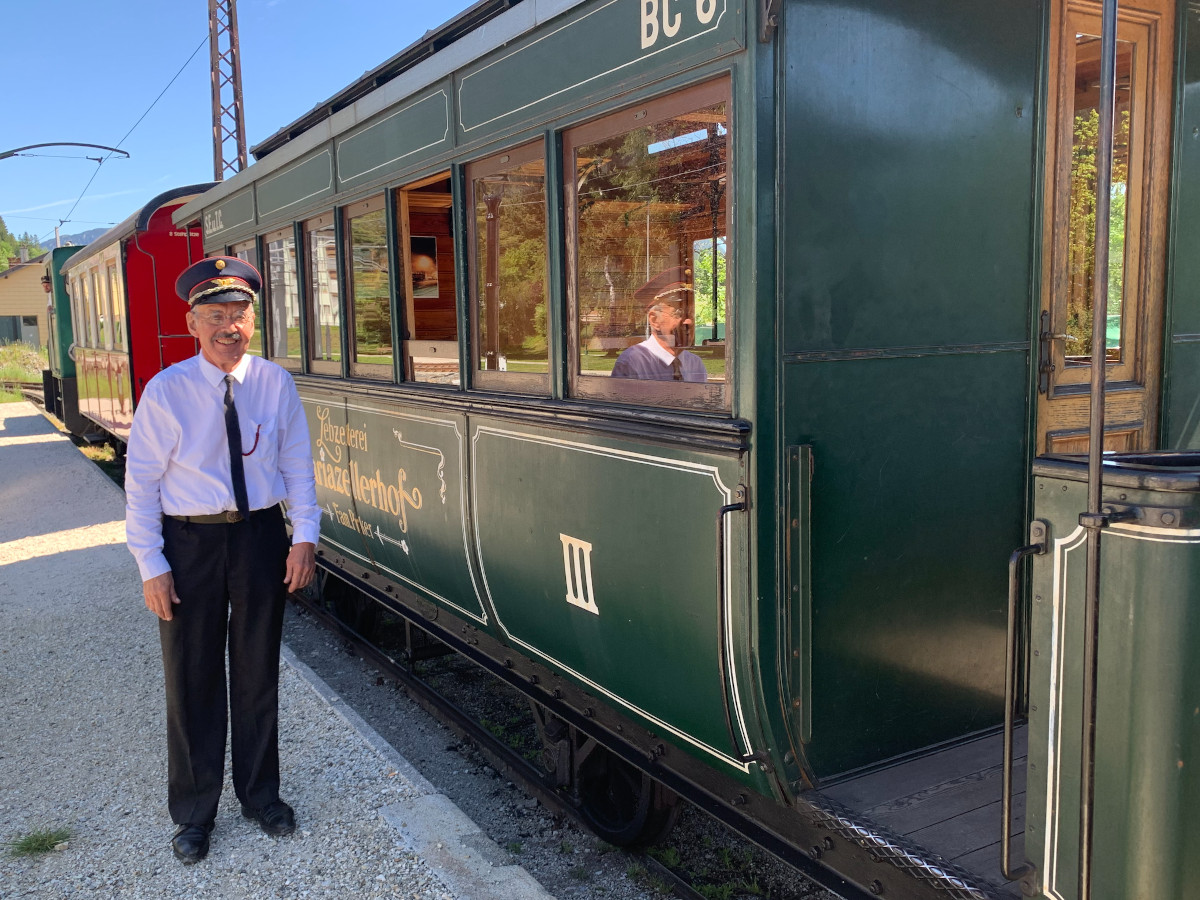
Thursday 28th May - day trip from St Poelten on the Mariazellbahn to Mariazell - not included in the pass and no discount but worthwhile. The Mariazellbahn is a 760mm (narrow gauge) line starting from a side platform at St Polten - half an hour by train from Vienna (though we are staying in St Poelten). It starts off through relatively low lands, winding never the less around fields and over level crossings and then the scenery changes and it runs up an alpine valley past pleasant Austrian homes up to Laubenbachmuhle. From there it becomes a mountain line, curving back and forth on itself to gain height and then - high above the valley - it passes through the 2km Gosing tunnel at 892 metres above sea level. From there it sits high on the ridge, falling just a little to the terminus at Mariazell - or, rather, just over half a mile short of Mariazell.
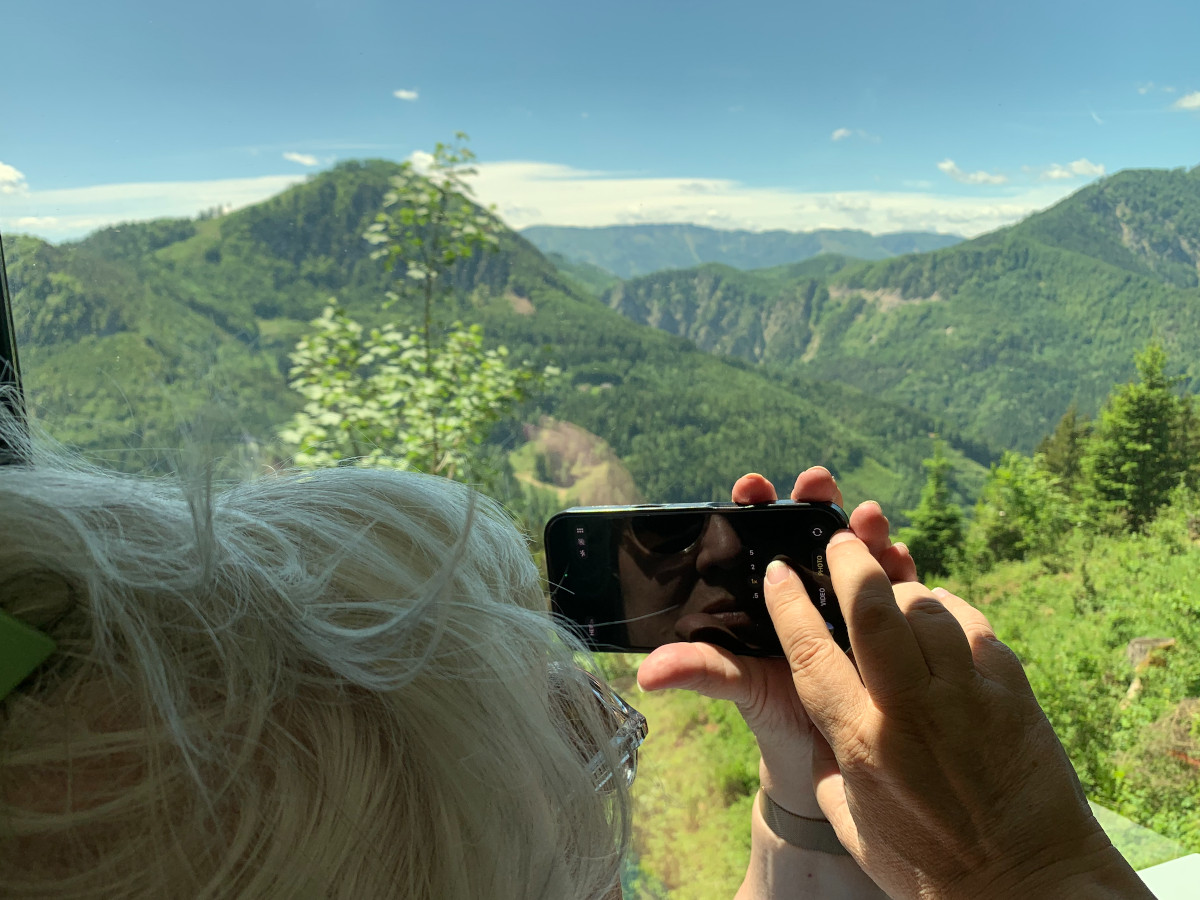
The line was electrified very early on when steam locomotives struggled, and these days the daily services are operated by modern spacious articulated 3 carriage trains which give lie to the narrow gauge. Well - where I say "spacious" we could have done with 6 carriages not 3, as we were joined in both directions by organised tours who had booked most of the seats. Smooth ride, though careful as you walk around with all those corners. Good visibility. The timetable shows panorama cars on some high season services, and occasional steam trains too. But not yesterday - trains leave St Polten every hour (and more in the commuter peak), with some carrying on to the mountain section to Mariazell. Looking at it as something of an aficionado of timetables, it's cleverly organised to cope - just - with the passenger flows offered.
Trains run "clock face" - from St Poelten at :37 and from Mariazell at :06 (with gaps) on a single track line. On the hour and half hour (:00 and :30) there are passing loops and the train pass each other with minimal delay. Other loops allow for the peak and high season extras to pass too. Signalling is inconspicuous and efficient - no stopping here to exchange tokens, or sitting in the middle of nowhere to wait for a train coming the other way on awkwardly located loops.
There are many stations along the way - and many of them are request stops. Clear screens on the train tell you to press the button if you want the train to stop, and the screen registers your request with the big word STOP in red. In the platforms of the "halts" there are button to press if you want the train to call (one button for each direction) and this means the train does not need to slow down in case someone is waiting and sticks their hand out as happens in England.
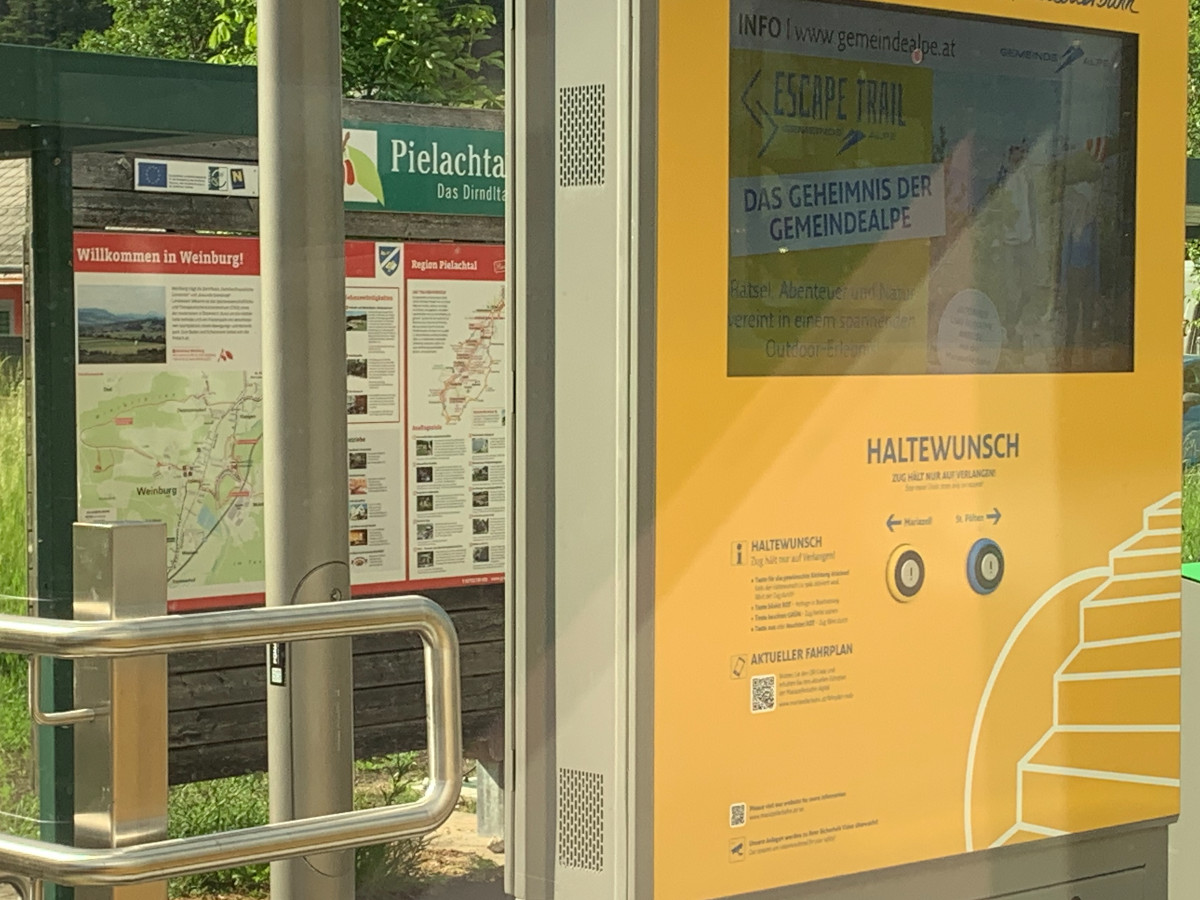
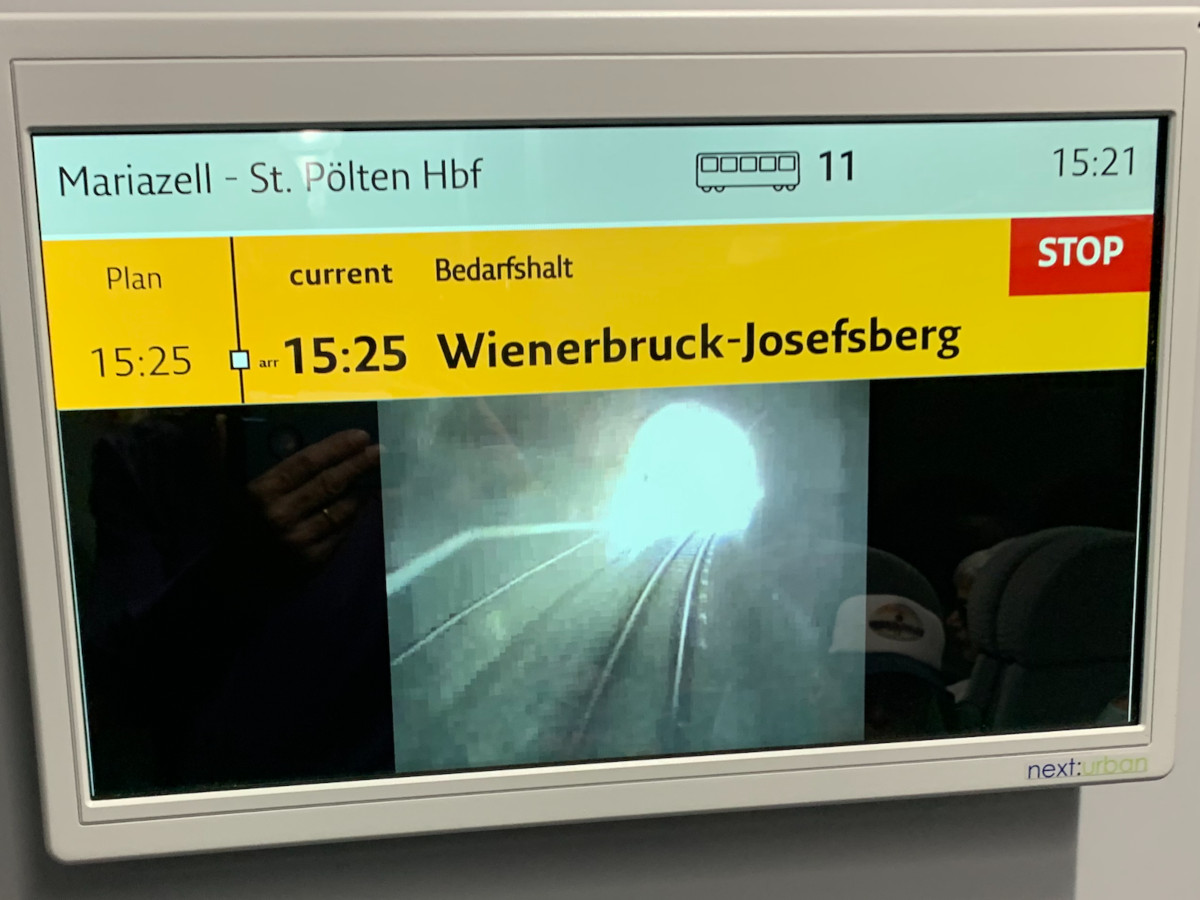
It's all the more remarkable how obvious the information is when we don't speak the local language very much, and yet we can work things out. A high proportion of people here don't understand / speak English either and we are certainly on something of a local adventure.
There was a small step up at St Polten into the train (and a wheelchair ramp the train manager could deploy if necessary. At Mariazell for the return, incredibly, it was level access and the train has an extending flap that removes the gap between the train and platform. I was across the yard looking at the old Salzburg museum train when our return train arrived, and Lisa boarded unassisted - it's good, but pity it's one step down at St Poelten. And you can get caught out there looking for the lift to the concourse.
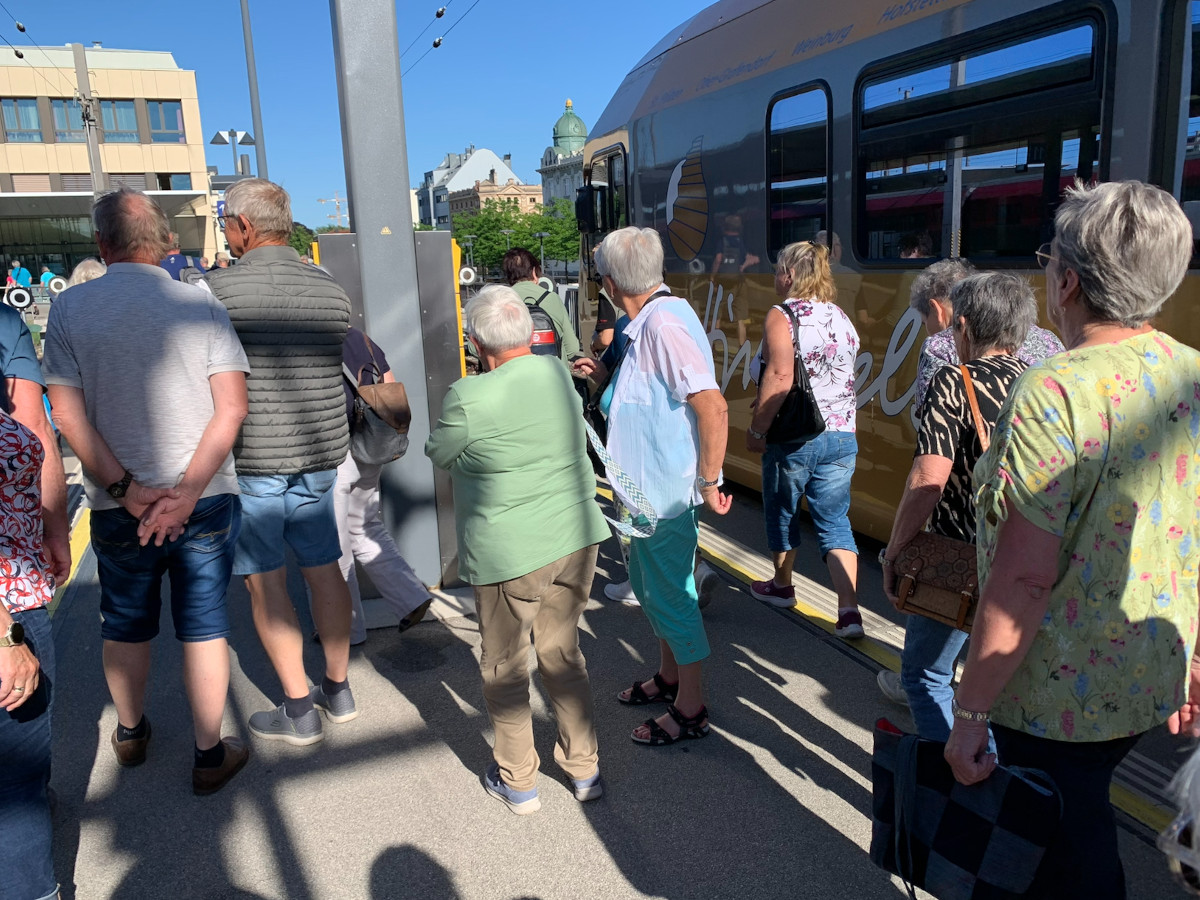
The party leader of the tour group wasn't at all pleased with me joining the return train in the same carriage as Lisa had boarded when I finished learning about the Salzburg local carriages of Victorian vintage - pointing out (incorrectly) that it was all reserved and I should choose another carriage. However, the priority seat the Lisa had transferred to was not reserved (for his group or anyone else) and I joined her, and we were joined by other local travellers getting off and on along the way. A common language in smiles and gestures, and Lisa has a little German. As seems to be the norm, a smile of friendship and a moving things around to make it comfortable for everyone does wonders with the locals, while the tour groups (and, yes, they were German speaking) take a holier-than-thou stance and are the least friendly of fellow travellers - that is a wider observation. A big "thank you" though to the one gent who was passing Gluewine around on the way up and when I offered a smile and signed a thumbs up gave me a little too. There's a psychology in the groups - extends to them thoughtlessly blocking platforms and not letting others through; I suspect being on holiday gives some of them permission to switch off their brains and I'm sure they're nice at home. Having said which, I'm sure that a consistent - day in, day out flow of groups has helped keep the line alive, open, and with a decent service.
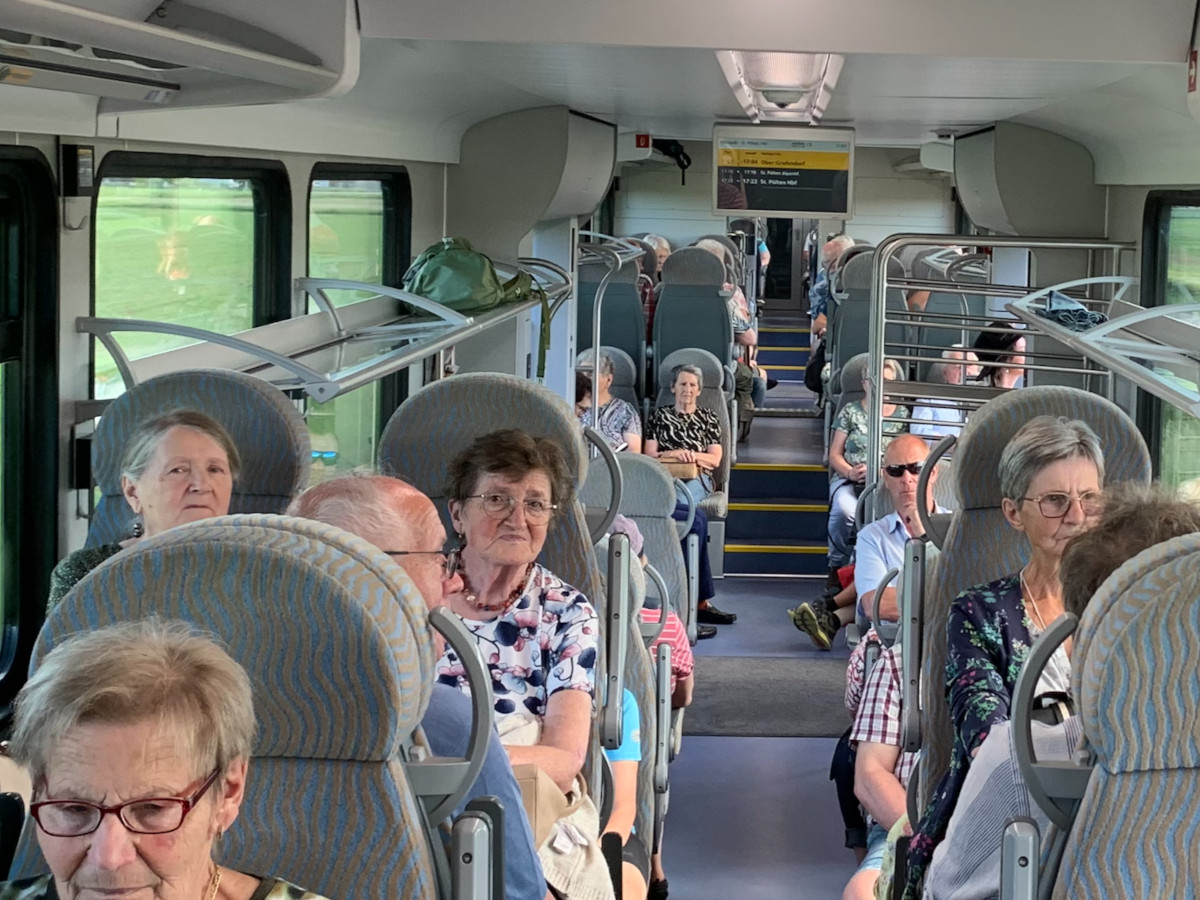
We loved the information screen which gave all connecting local buses on the approach to each station, advertised what was going on in the area on future days, and attractions, and in quieter times gave us the driver's view looking ahead on a webcam. All very well done.
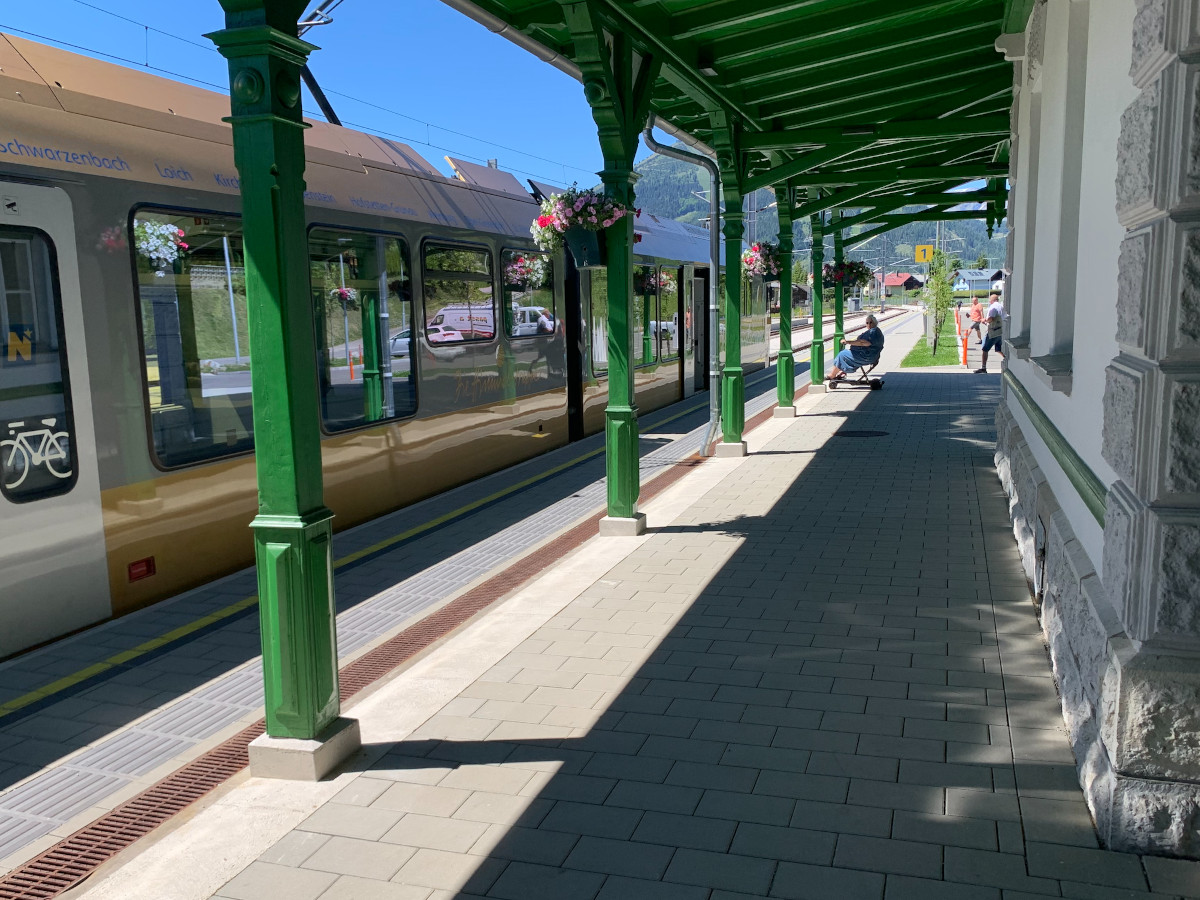
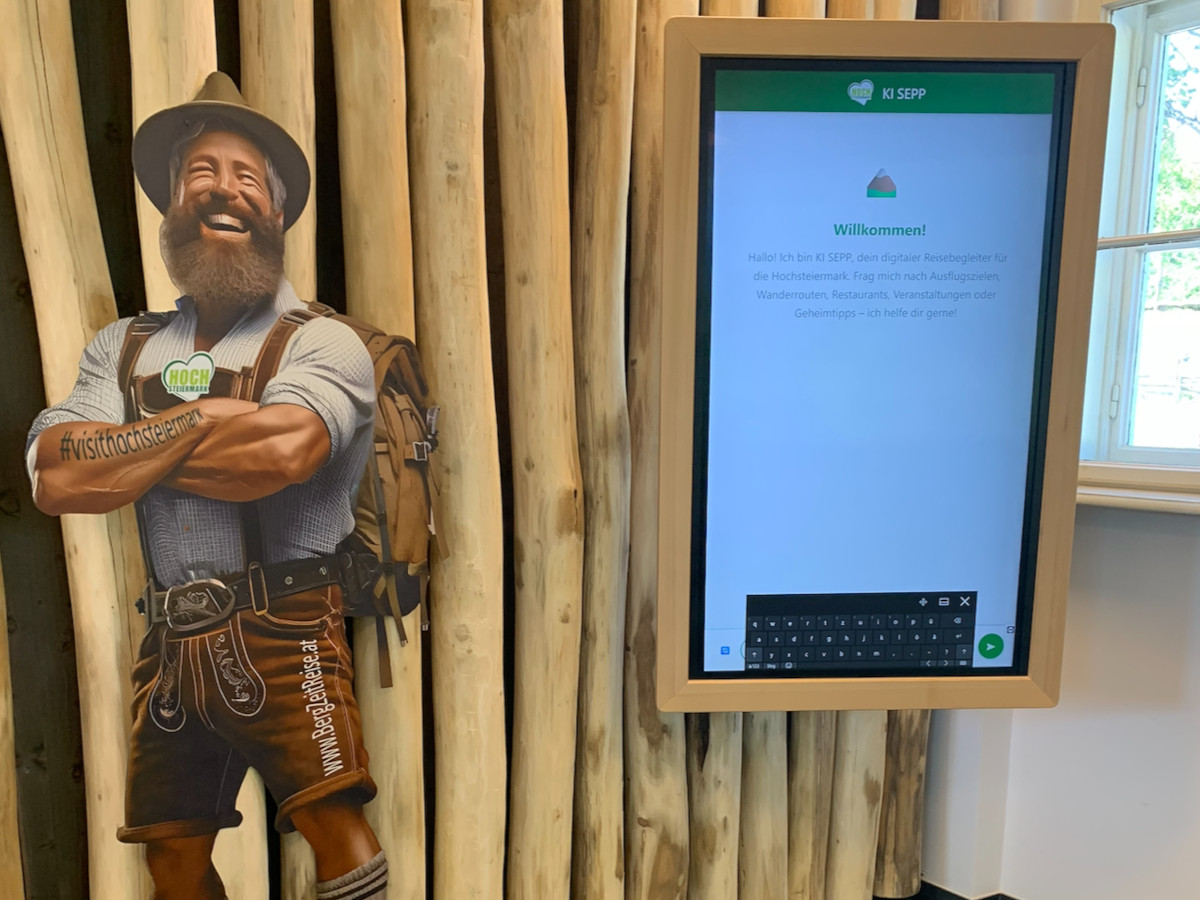
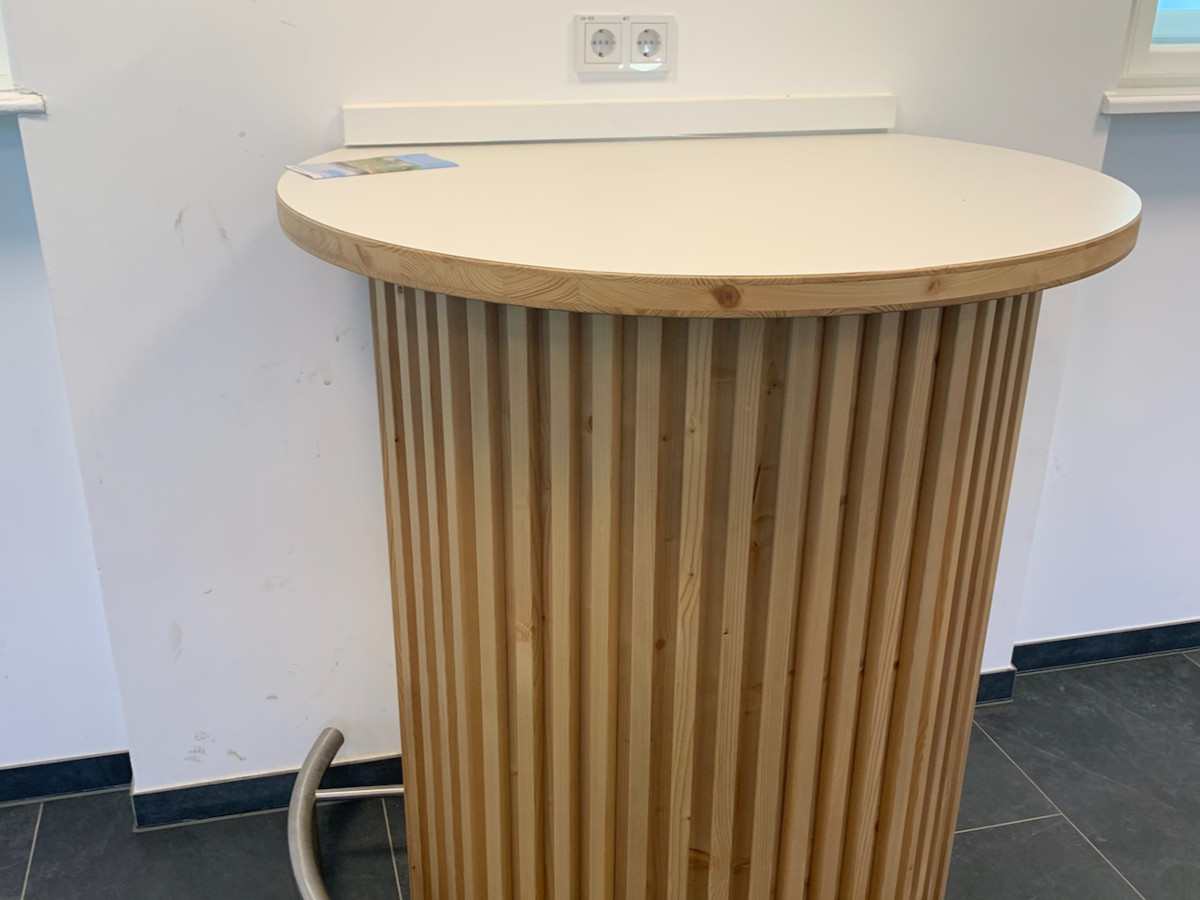
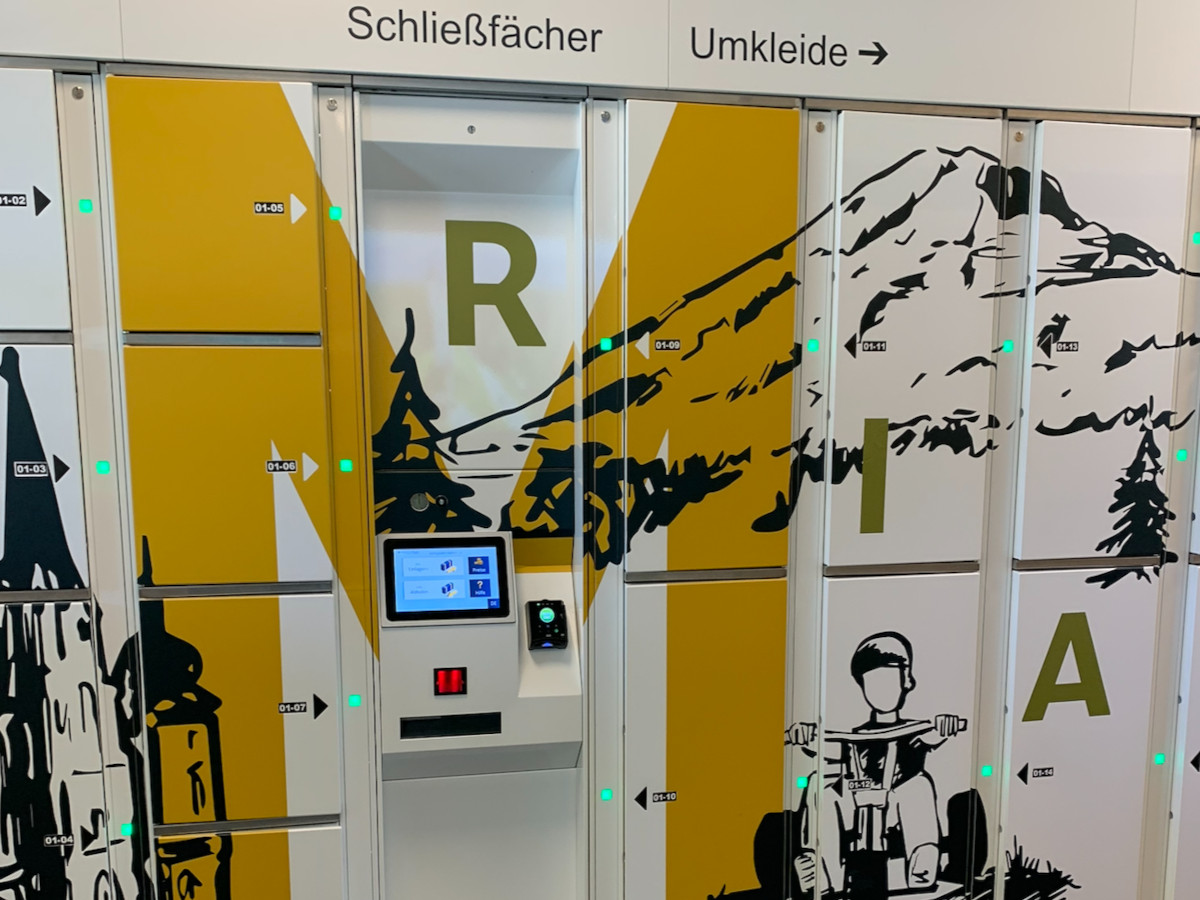
The station building at Mariazell is lovely - multiple platforms, run round loop, clean, flowers, and a heated waiting room which is full of ideas and thoughts for our upcoming "Information at the Station" project. Some elements are over the top - we're probably not in need of ski storage lockers, and not going to have a display case of goods which you can order online via QR codes for - I would presume - home delivery. Seating, a big interactive information board, other screens telling you about upcoming bus and train departures, and plenty of power points clearly positioned to help people looking to charge devices with stashing and desk space around. And literature racks, carefully collated into separate public transport and other local attraction sections. Open 9 a.m. to 7 p.m. which coincides with the full running time of the train on the upper section of the line from the arrival of the 06:37 from St Polten to the departure of the 19:06 back.

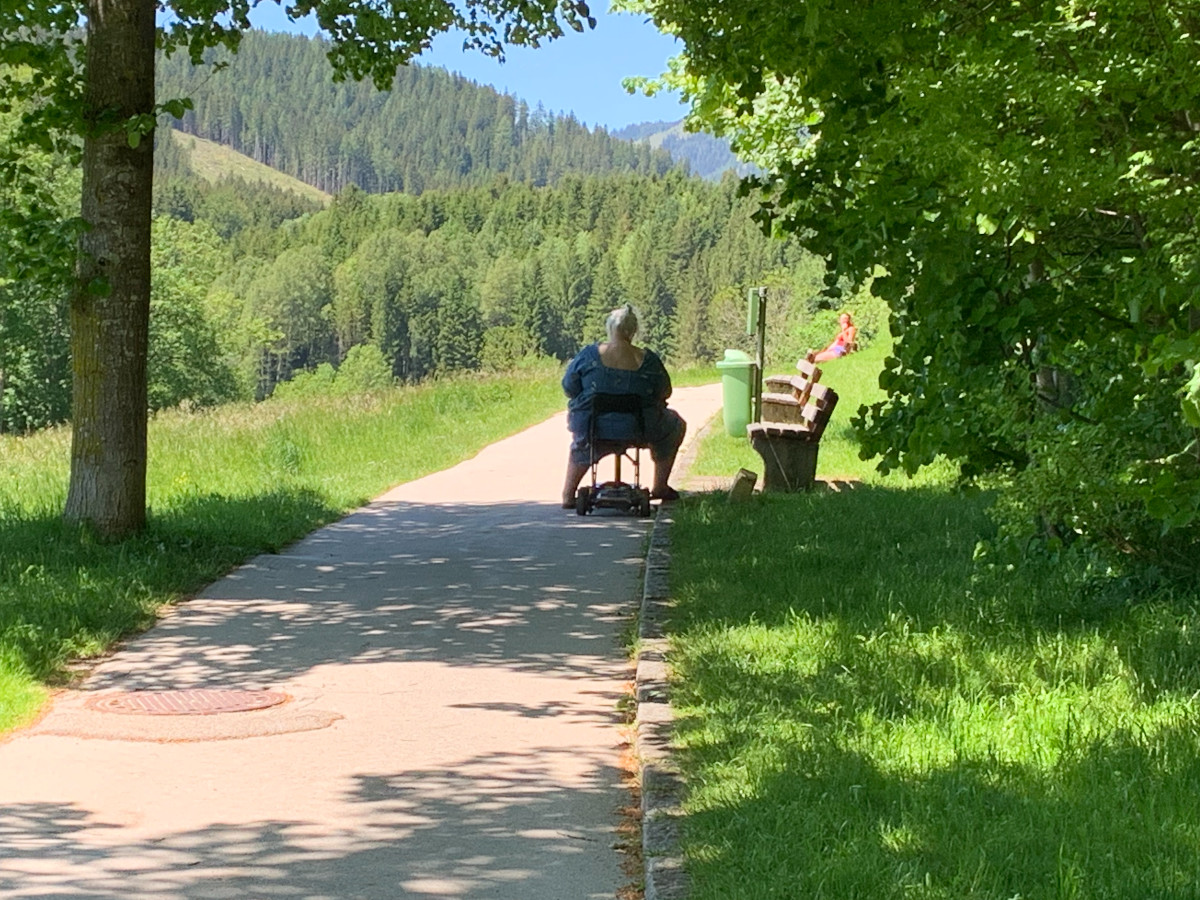
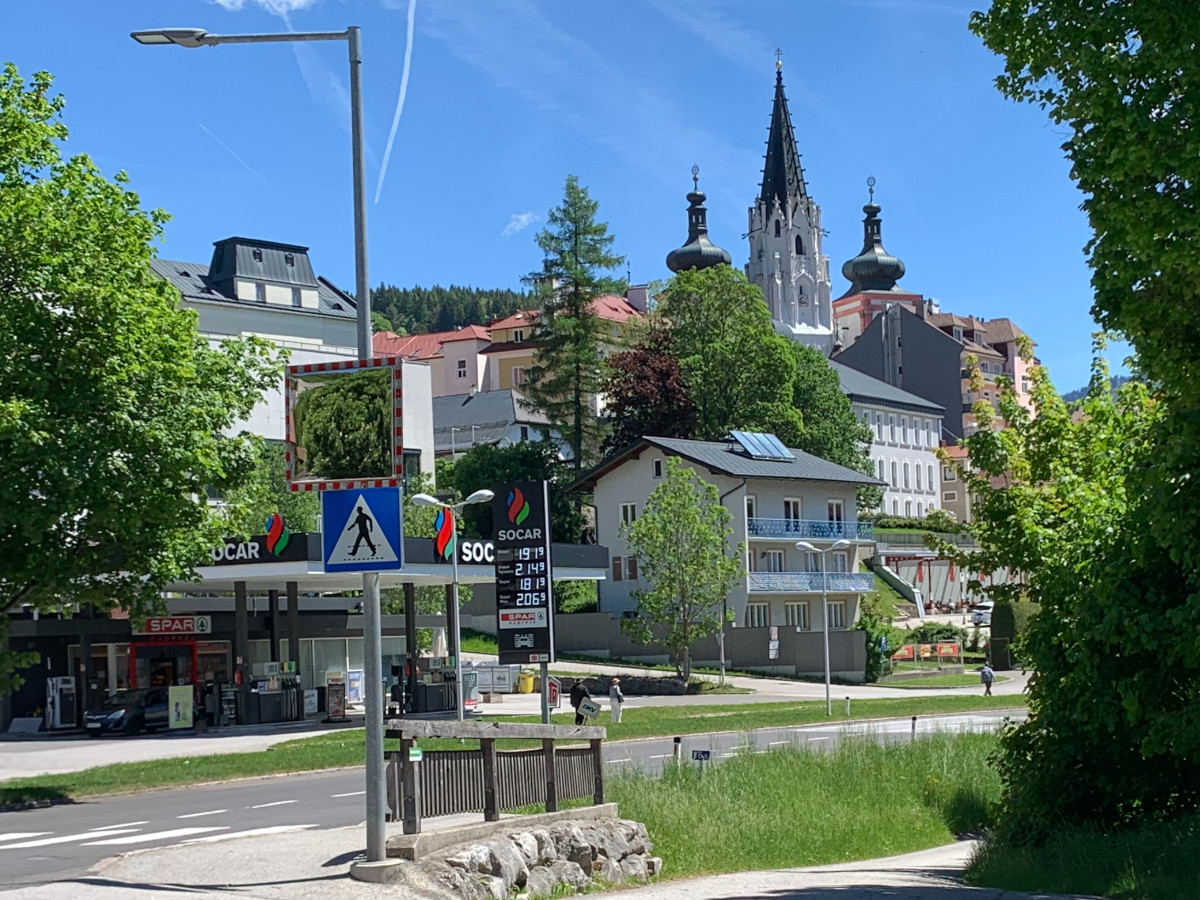
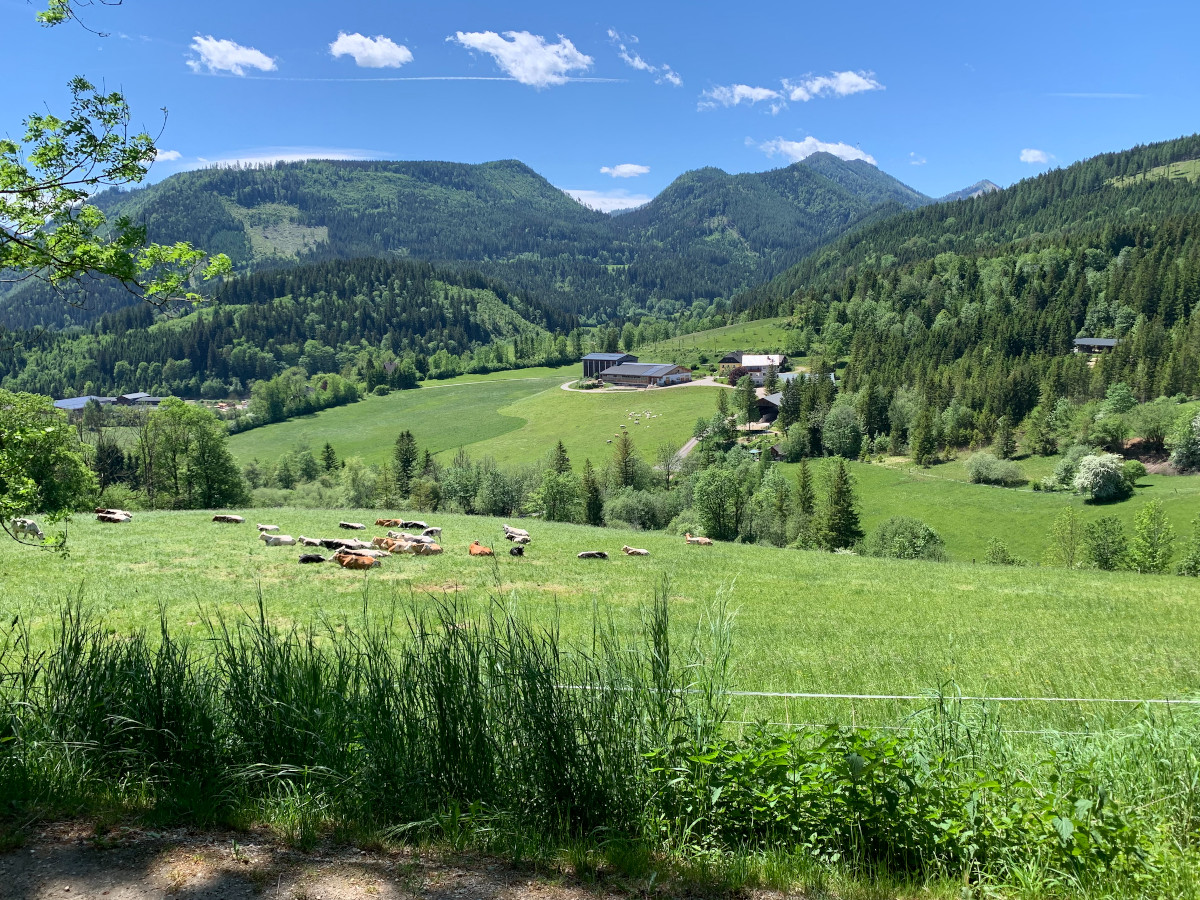
And here I am - deep into writing - what of Mariazell itself? The town is the best part of a mile from the station; some trains do have bus connections but rather that research those we set off along a lovely path, part of which doubled as a local road to some houses. Lisa had trouble with a policeman along there - grounded Henry on a sleeping one, but a bit of a push from me helped clear that; nearly toppled over on the return trying to go around the end. To keep travel light, we hadn't taken our charger with us and - seeing the route falling from the station to the town, with the town and basilica looming up ahead of us we stopped short. A lesson for following days - I'm sure that with the charger we would have made it to a cafe in the town and been able to get back - but whilst we travel brave, we don't take foolish risks like being left marooned with flat batteries. No problem *to us* - I understand there are interesting relics and things to see in Mariazell, but more interesting to others. We utterly enjoyed the walk, just a very few others on it and remote enough for another gent to step just off the path and pee in the bushes. Meadows, cows, mountains - real "Sound of music" countryside - even the tunnel, you may note, was called Gosing or is that go-sing.
https://en.wikipedia.org/wiki/Mariazell_Railway
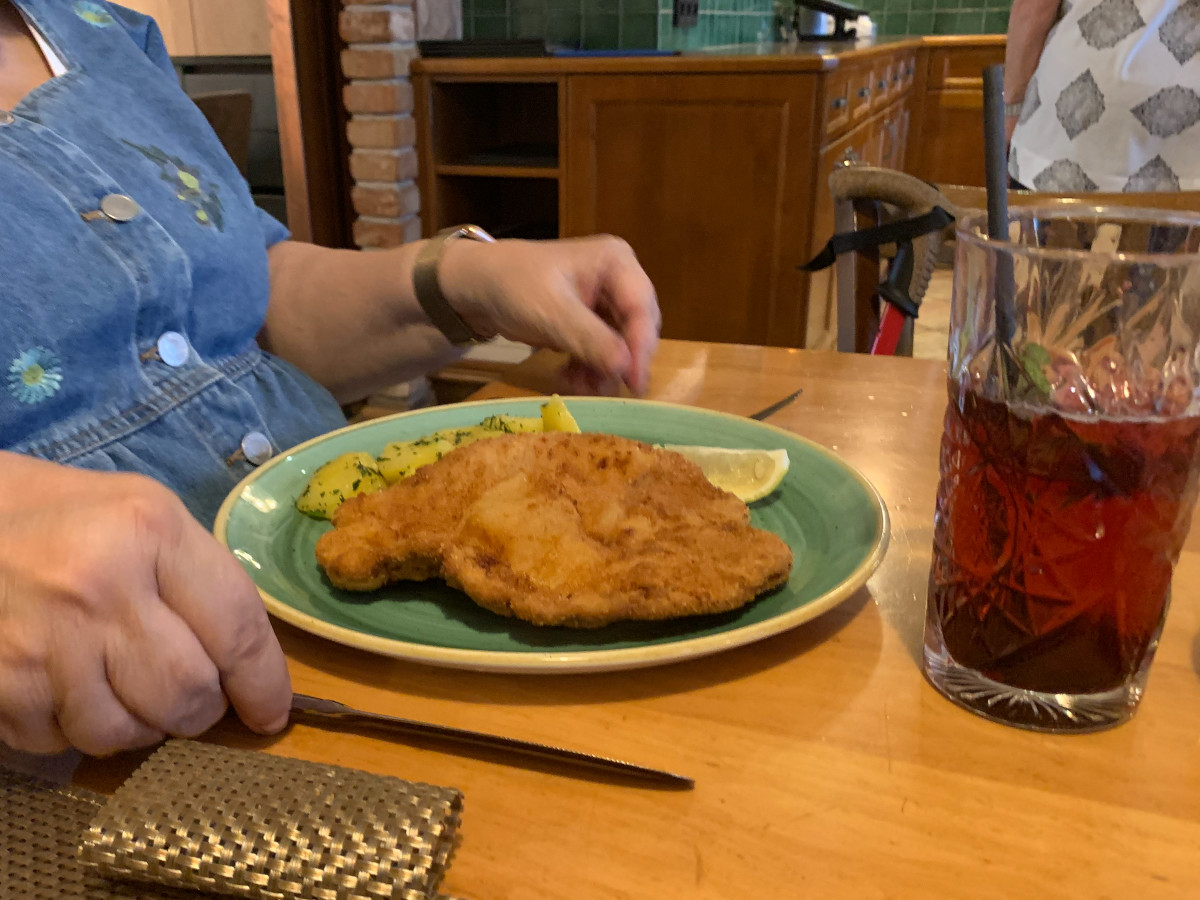
P.S. Our shortened stay in Mariazell due to lack of battery had another silver lining - an earlier return to the hotel and a chance to eat the local food
| RailFuture Severnside AGM - 13th June 2026 In "Diary - what's happening when?" [375615/32083/34] Posted by grahame at 06:46, 29th May 2026 | |
Dear Mr Graham Ellis
Railfuture Severnside event on Saturday 13th June 2026
I would like to invite you to Railfuture Severnside's annual general meeting. It will be on Saturday 13th June at 1.30pm at Chippenham Rotary Hall, 16 Station Road, Chippenham, SN15 1EG.
The hall is just a few minutes' walk from Chippenham station and the route(see Google map below), the entrance to the hall, and all the facilities are fully accessible.
All are welcome to attend (though only members may vote) so please feel free to extend the invitation to family, friends and colleagues who aren't members of Railfuture. New members can join online and subscriptions start at £10 per year.
We will send you an agenda nearer the time but we expect to have presentations about the main issues and developments in our region.
Look forward to seeing you there.
For details about the Severnside branch, please see: www.railfuture.org.uk/Severnside+Branch.
Regards
Bruce Williamson and John Henderson
Railfuture Severnside
Email: severnside@railfuture.org.uk
Railfuture is an independent national volunteer-run organisation campaigning for a bigger better railway in Britain with more reliable services
How we spell Railfuture — singular, one word, one capital letter (can be abbreviated to Rf)
Railfuture Severnside event on Saturday 13th June 2026
I would like to invite you to Railfuture Severnside's annual general meeting. It will be on Saturday 13th June at 1.30pm at Chippenham Rotary Hall, 16 Station Road, Chippenham, SN15 1EG.
The hall is just a few minutes' walk from Chippenham station and the route
All are welcome to attend (though only members may vote) so please feel free to extend the invitation to family, friends and colleagues who aren't members of Railfuture. New members can join online and subscriptions start at £10 per year.
We will send you an agenda nearer the time but we expect to have presentations about the main issues and developments in our region.
Look forward to seeing you there.
For details about the Severnside branch, please see: www.railfuture.org.uk/Severnside+Branch.
Regards
Bruce Williamson and John Henderson
Railfuture Severnside
Email: severnside@railfuture.org.uk
Railfuture is an independent national volunteer-run organisation campaigning for a bigger better railway in Britain with more reliable services
How we spell Railfuture — singular, one word, one capital letter (can be abbreviated to Rf)
| Re: The People's Emergency - film, free, 27.5.2026 In "Diary - what's happening when?" [375614/32079/34] Posted by grahame at 04:32, 29th May 2026 | |
sounds a worthwhile cause. Do they propose any sensible solutions to the many problems we face.
Don't know ... hoping to get a report
 . ...
. ...Two shareable reports ...
Went to filming last night.
Everyone needs to see this
Everyone needs to see this
and
Heartffelt thanks to those who helped with publicity and with last night. It was such a relief that we got 30 people watching + 7/9 of our members and MP +2 staff.
Background to that last comment ... as a free event with no need to register, our chair had been concerned that we would have an empty hall. The concern was compounded when a number of the key movers and shakers who should have been attracted had a prior scheduled (Melksham Area Board) meeting
| Re: Journey Log - and some lessons to learn - Melksham to Harwich In "Introductions and chat" [375613/32073/1] Posted by grahame at 04:13, 29th May 2026 | |
Google tells me the distance is 991 kms
As an addendum, I commented to Lisa that we did 1000kms and she mused that with the RailJet reporting speed of 200kms per hour, it should have taken 5 hours and not almost 11! For comparison, London to Ullapool - ferry for Stornoway - is reported as being 992kms.
A good reminder to me that high speed rail may be great in many aspects, but the faster you make some sections, the more disproportionally significant the other bits in the equation become. Our 11 hours includes multiple reversals of the Amsterdam to Munich train - Koln and Stuttgart, engineering diversions which - however - were planned into the timetable / journey planner well ahead, a total of perhaps 80 minutes waiting in Arnhem, Augsburg and Salzburg as we made connections, intermediate station stops, and slower running on less high speed sections.
In the end, we had "budgeted" for 10.5 hours and knowing how budgets overrun, allowed for / expected a bit extra in notifying the hotel of our expected arrival time. And we had a "plan B" that would have allowed us to drop back and arrive later if stuff had gone wrong. Really happy with the journey, though tired on arrival.
P.S. Google also reports just under 11 hours London to Stornoway, by driving or by public transport
| Re: Swindon <-> Westbury service updates and amendments, ongoing discussion - 2026 In "TransWilts line" [375612/31359/18] Posted by grahame at 03:54, 29th May 2026 | |
Just for the record, but hopefully everyone will be pleased that all the Oxford<>Bristol’s ran again today…as well as all of the services through Melksham!
Yes - and thank goodness. How it should be.
As a separate note, the 20:06 Westbury to Cheltenham Spa via Swindon (2G91) was flagged up as cancelled ... "This service was cancelled due to the planned cancellation (was not planned to operate) (PD)". However, a train 2Z91 ran in its path ... and from my logs looks like that's been the case earlier this week too. Not an Oxford <-> Bristol issue / even for comparison, so I'll let's comment further (if we want) on the TransWilts log.
| Re: New Oxford - Bristol direct service, ongoing developments and discussion In "Oxford, Didcot and Reading from the West" [375611/28355/22] Posted by grahame at 03:52, 29th May 2026 | |
Just for the record, but hopefully everyone will be pleased that all the Oxford<>Bristol’s ran again today…as well as all of the services through Melksham!
Yes - and thank goodness. How it should be.
As a separate note, the 20:06 Westbury to Cheltenham Spa via Swindon (2G91) was flagged up as cancelled ... "This service was cancelled due to the planned cancellation (was not planned to operate) (PD)". However, a train 2Z91 ran in its path ... and from my logs looks like that's been the case earlier this week too. Not an Oxford <-> Bristol issue / even for comparison, so I'll let's comment further (if we want) on the TransWilts log.
| Re: New Oxford - Bristol direct service, ongoing developments and discussion In "Oxford, Didcot and Reading from the West" [375610/28355/22] Posted by IndustryInsider at 01:03, 29th May 2026 Already liked by Mark A | |
Just for the record, but hopefully everyone will be pleased that all the Oxford<>Bristol’s ran again today…as well as all of the services through Melksham!
| Re: Class 175s to Great Western Railway (GWR) In "Across the West" [375609/28982/26] Posted by trainbuff at 23:24, 28th May 2026 Already liked by trainbuff | |
You can't polish a turd: Voyagers are crap.
That's only my personal opinion, based on experience, by the way: not an official view from the Coffee Shop forum. CfN.
 :-But you can roll it in glitter!
That's only my personal opinion, based on experience, by the way: not an official view from the Coffee Shop forum. CfN.
 :-But you can roll it in glitter!
| Re: Class 175s to Great Western Railway (GWR) In "Across the West" [375608/28982/26] Posted by trainbuff at 23:23, 28th May 2026 | |
20 mins later boarded my first refurbed XC Voyager... reasonable enough but they still seem not to have sorted out that unpleasant air in the carriages containing the WCs.
They are what they are
| Re: Overhead Line Equipment - ongoing discussion In "Campaigns for new and improved services" [375607/31031/28] Posted by Mark A at 21:02, 28th May 2026 Already liked by PrestburyRoad | |
Seeing the 6 and 7 bus service in Bath operated by an electric bus today - and also Flixbus provisioned with an electric coach on the (competitive in price but not timings) run up to London - and a portion of the cars (and bikes) on the road being electric - this was thought-provoking.
I'm put in mind of the nineteen fifties and a steam-operated rail system that was demanding of the people who worked in it, was in retrenchment, struggling to attract staff, running timetables that were sometimes obsolete and not a good fit with changing times, subject to wild swings in political interference, dependent on public subsidy having poured a lot of its strength into the war - with the public increasingly no longer looking to the railway for transport, turning to buses and, if they could, motor cars instead, given a big push at the time with the building of toll-free, free-at-the-point-of-use motorways - this despite the fact that many cars of the time weren't exactly brilliant (and many of said vehicles, not engineered for continuous high speed cruising, were killed by those same motorways)**.
Long distance trips by train to holiday destinations became long distance trips by car, day or night: perhaps a child in the back seat tasked with care for another new device, the transistor radio, turning it as needed to maintain reception.
I'm wondering how much a similar impression might bite today, when the railway, particularly in the west, diesel-fuelled and operating long distance services using expensive and complex stock whose interior air quality was found at one point to be not particularly brilliant, while many other branch and inter-regional services are provisioned for the foreseeable with the externally very noisy likes of the class 166.
Also, part of the national picture is that HS2 has taken a swing at the future, but with the cuts to core pieces of its design, will not fulfil the primary task of capacity enhancement for the national network itself - without further changes, the role that HS2 could play has been to a large extent closed down - and its costs have risen.
Returning to the parts of the railway that are running on diesel, unreliable and unable to provision their timetables, is this industry in danger of imminently presenting as yesterdays mode of transport, running on yesterday's technology?
Thankfully the overall picture is (hopefully) more rosy, but I do wonder about the margins (and in some ways those margins, for the GWR, begin east of Chippenham, north of Didcot, west of Cardiff, south of Reading, and there doesn't seem to be a plan to change that, even though the rising cost (& fragility) of the oil-based economy is surely providing a spur.)
Mark
tl:dr - batteries won't do everything, where is the rolling programme of electrification that's clearly needed?
**A friend of a friend who drove... it was either an Austin Devon or Somerset... gave me a lift from Llanbadarn, Aberystwyth, up the road called Heol y Bont to Penparcau. The short trip was... an education, but those weren't cars to which people had great exposure. Many more people will recall what didn't happen very much when the brake pedal of, say, a Morris Minor, was depressed - not much, compared to current vehicles...
(The friend of a friend having dropped me off was heading to Lampeter - sometimes I wonder if he's there yet...)
| Re: Class 175s to Great Western Railway (GWR) In "Across the West" [375606/28982/26] Posted by REVUpminster at 20:14, 28th May 2026 | |
175116 to Laira today. Delayed for 70 mins near Acton Wells but arrived 8 minutes early at Laira
Ely :3: 175005/008, 175104 (175008 is in two halves)
Wolverton :9 : 175004, 175102/103/105/106/107/108/109/110
Laira : 14: 175002/007/009, 175114 ex Ely; 175001/003/006/011, 175101/111/112/113/115/116 ex Wolverton
Long Rock : 1 : 175010 ex Ely
as of 28 May 2026
| Re: Wokingham station - improvements, resignalling and siding - merged posts In "South Western services" [375605/11448/42] Posted by bobm at 20:03, 28th May 2026 Already liked by Chris from Nailsea, Mark A, rogerw | |
I didn’t. However I did see it cross the river bridge at Staines last Friday but I had a pint in one hand and a handbag in the other at the time. (Don’t ask).
| Re: Wokingham station - improvements, resignalling and siding - merged posts In "South Western services" [375604/11448/42] Posted by stuving at 19:42, 28th May 2026 Already liked by Mark A | |
I did wonder whether bobm tried to coincide with 701006 on its daily visit. If you stand on the footbridge to get a clear view of the box, you see hardly any of the livery, just the end of the train which is almost a livery-free zone. From the ground you end up peering through a thicket of streetware. But you can still see one small step of premature "demolition" - someone has made off with the name sign of the front. Not NR, I suspect.
Incidentally, I'm assuming the scruffy shack (or relay room) behind the box will be going as well. It would be a shame to lose a decent bit of railway vernacular and leave that prominently on view.
| Re: Shortage of train crews on Great Western Railway - ongoing discussion In "Across the West" [375603/18719/26] Posted by ChrisB at 18:43, 28th May 2026 | |
Agreed that they haven't yelled from the rooftops about it, but we've discussed here in the forum the removal of late night/early morning services to thin out the service....
| Man killed by train near Welwyn North after escaping custody van - 28 May 2026 In "The Wider Picture in the United Kingdom" [375602/32082/51] Posted by Chris from Nailsea at 18:30, 28th May 2026 | |
From the BBC:
Man killed by train after escaping custody van
A man hit and killed by a train had escaped from a custody vehicle travelling from a police station to court, police said.
The man, in his 40s, escaped the transport contractor's vehicle as it was stationary on the A1(M) motorway, a joint statement from Hertfordshire Police and British Transport Police (BTP) said. It said during a search of the area, BTP was called at about 09:40 BST to a casualty on the track near Welwyn North railway station.
The statement said formal identification had not taken place, but the man's family had been made aware.
Hertfordshire Police said the vehicle had been travelling from the custody suite at Stevenage police station.
The forces said two members of transport contractor staff were injured "during an altercation in the van" and were taken by ambulance to hospital for treatment. It happened at about 09:00.
Hertfordshire Police has referred the incident to the Independent Office for Police Conduct. A file has been prepared for the coroner.
Inquiries are continuing "to establish the full circumstances and officers will remain in the area while initial investigations continue", a spokesperson said.
David Elsdon, 82, who lives close to the station in the village of Digswell, said he had never seen so many police before and it "was all a bit of a shock".
"We were just out the front ready to leave for the town and inundated with a number of police cars coming along," he said. "I think we passed 10 in total before we got out on to the main road."
National Rail said earlier Thameslink, LNER and Great Northern trains, from London through Hertfordshire, Peterborough and Cambridgeshire, had been delayed but the line had reopened with some delays and cancellations still expected.
A Thameslink spokesperson confirmed one of its trains had been involved in the incident. They advised people travelling by train to check their route beforehand.
A man hit and killed by a train had escaped from a custody vehicle travelling from a police station to court, police said.
The man, in his 40s, escaped the transport contractor's vehicle as it was stationary on the A1(M) motorway, a joint statement from Hertfordshire Police and British Transport Police (BTP) said. It said during a search of the area, BTP was called at about 09:40 BST to a casualty on the track near Welwyn North railway station.
The statement said formal identification had not taken place, but the man's family had been made aware.
Hertfordshire Police said the vehicle had been travelling from the custody suite at Stevenage police station.
The forces said two members of transport contractor staff were injured "during an altercation in the van" and were taken by ambulance to hospital for treatment. It happened at about 09:00.
Hertfordshire Police has referred the incident to the Independent Office for Police Conduct. A file has been prepared for the coroner.
Inquiries are continuing "to establish the full circumstances and officers will remain in the area while initial investigations continue", a spokesperson said.
David Elsdon, 82, who lives close to the station in the village of Digswell, said he had never seen so many police before and it "was all a bit of a shock".
"We were just out the front ready to leave for the town and inundated with a number of police cars coming along," he said. "I think we passed 10 in total before we got out on to the main road."
National Rail said earlier Thameslink, LNER and Great Northern trains, from London through Hertfordshire, Peterborough and Cambridgeshire, had been delayed but the line had reopened with some delays and cancellations still expected.
A Thameslink spokesperson confirmed one of its trains had been involved in the incident. They advised people travelling by train to check their route beforehand.
| Re: Shortage of train crews on Great Western Railway - ongoing discussion In "Across the West" [375601/18719/26] Posted by John D at 18:19, 28th May 2026 | |
According to Mark Hopwood yesterday at Travelwatch Southwest, further cuts are being made to the Summer Sunday timetable at the May timetable change, as part of the management of this problem.
........as part of the failure of management of this problem - fixed it for you!
ORR have issued new quarterly figures, and according to table 1.3 GWR has planned to cut 2% of services compared to previous year.
https://dataportal.orr.gov.uk/media/4pmhex4x/performance-stats-release-jan-mar-2026.pdf
So all the PR spin of increasing services to Newquay, and introducing Bristol-Oxford there is an overall cut (which has rather been kept under the radar)
| Re: Overhead Line Equipment - ongoing discussion In "Campaigns for new and improved services" [375600/31031/28] Posted by IndustryInsider at 16:50, 28th May 2026 Already liked by Mark A | |
Fair point on the re-instatement of through stopping services and given the battles Oxfordshire seem to be waging against the motorcar, surely there must be a reasonably good case for Oxford North and South stations too?
If that were the case then extending the wires and an Oxfordshire Metro to Banbury would seem very sensible and relatively inexpensive.
Of course the problem is that Labour are unlikely to want to be seen to be spending money on posh southerners ;-)
Wiring from Didcot through to Hanborough has been mooted a few times over the years and is probably a better bet than Banbury. Can't see the money being stumped up any time soon though!
Oxford Parkway is a kind of Oxford North station already. Mind you, you can't really go north from it until East West Rail finally starts up, when connections at Milton Keynes will make sense for some journeys to the north.
| Re: Overhead Line Equipment - ongoing discussion In "Campaigns for new and improved services" [375599/31031/28] Posted by Noggin at 16:41, 28th May 2026 | |
I can't see anything happening at Oxford until the station rebuild is complete - in any case, the only real advantage would be that 387's could free up 80x.
No, the real advantage would be restoring a proper stopping service all the way from Reading to Oxford, that we haven't had since the introduction of the split service necessitated by the abandonment of electrification beyond Didcot. The lack of direct trains from all stations between Tilehurst and Cholsey to Oxford, all relatively busy stations with reasonably large local populations and hinterlands, is just as much a gap in the GWR network as the recently remedied lack of direct Bristol - Oxford services. A number of our acquaintances in Goring and Streatley say that they have given up going to Oxford, either entirely or by public transport, as a result.
See also Marlburian's post early today. We might be a prosperous corner of the country between Reading and Oxford, but it doesn't help encouraging the use of public transport when something we used to take for granted has just disappeared with very little comment or outcry.
Thames Metro, now?
Fair point on the re-instatement of through stopping services and given the battles Oxfordshire seem to be waging against the motorcar, surely there must be a reasonably good case for Oxford North and South stations too?
If that were the case then extending the wires and an Oxfordshire Metro to Banbury would seem very sensible and relatively inexpensive.
Of course the problem is that Labour are unlikely to want to be seen to be spending money on posh southerners ;-)
| Re: Swindon <-> Westbury service updates and amendments, ongoing discussion - 2026 In "TransWilts line" [375598/31359/18] Posted by TaplowGreen at 16:38, 28th May 2026 | |
17:50 Gloucester to Salisbury due 20:06
17:50 Gloucester to Salisbury due 20:06 will be terminated at Westbury.
It will no longer call at Dilton Marsh, Warminster and Salisbury.
This is due to a fault with the signalling system.
| Re: Thunderstorms: 26/5/26 and counting. In "London to Swindon and Bristol" [375597/32078/10] Posted by JohnM at 14:30, 28th May 2026 | |
My wife tells me she's been hearing how extensive the damage is to people's property (in Melksham, 2 miles from us), and it's Act of God so not covered by insurance. Someone has been given a £3k quote to remove 60 dents from their car's roof

